From Indispensable Founder to Independent Business: Building Transferable Capability with Practical Copilot Support

Writer

A founder can be the company’s best salesperson, most capable problem-solver, and final authority on almost every decision. That can make the founder extraordinarily useful. It can also make the business difficult to transfer.
The tension is not that talented founders destroy value. It is that personal capability and organizational capability are different assets. If customers, employees, and operating decisions depend on one person, a buyer cannot assume that the company’s performance will survive that person’s departure.
For technically minded leaders, this is a familiar architectural problem: a critical system has a single point of failure. The solution is not to remove the founder’s contribution. It is to stop making that contribution a prerequisite for normal operation.
That requires documented knowledge, genuine decision authority, and evidence that the business can perform independently. Microsoft 365 Copilot and appropriately designed agents can help with parts of that work. They cannot substitute for it.
The useful question is not “How can AI make the founder faster?” It is “How can the organization use the founder’s expertise without requiring the founder’s presence?”
The valuation discussion is educational, not a business appraisal or investment recommendation. Illustrative multiples are assumptions, not market quotes or promises of sale proceeds. Technology examples describe proposed designs, not measured deployments or out-of-the-box solutions.
Personal capability and organizational capability are distinct assets. The goal of founder independence is not to eliminate unique leadership, but to remove the founder as an architectural single point of failure—turning tacit judgment into runbooks, delegating decision authority, and proving sustainable operations.
The capacity trap: when effort becomes the operating model
In a young business, routing work through the founder can be sensible. The founder knows the customers, understands the offering, and can resolve ambiguity quickly. Formal processes may cost more effort than they save.
But growth changes the equation.
Imagine a professional-services founder who insists on clearing every outstanding task before the weekend. Initially, Friday is enough. Later, the work spills into Saturday, then Sunday. Eventually, even the entire weekend cannot absorb the backlog.
The problem is no longer insufficient commitment. It is a design that assumes one person has unlimited capacity.
Hiring does not necessarily fix that design. If every employee still needs the founder to approve pricing, interpret requirements, resolve exceptions, or explain how work should be done, the organization has added execution capacity without adding decision capacity.
The founder remains the queue through which everything important must pass.
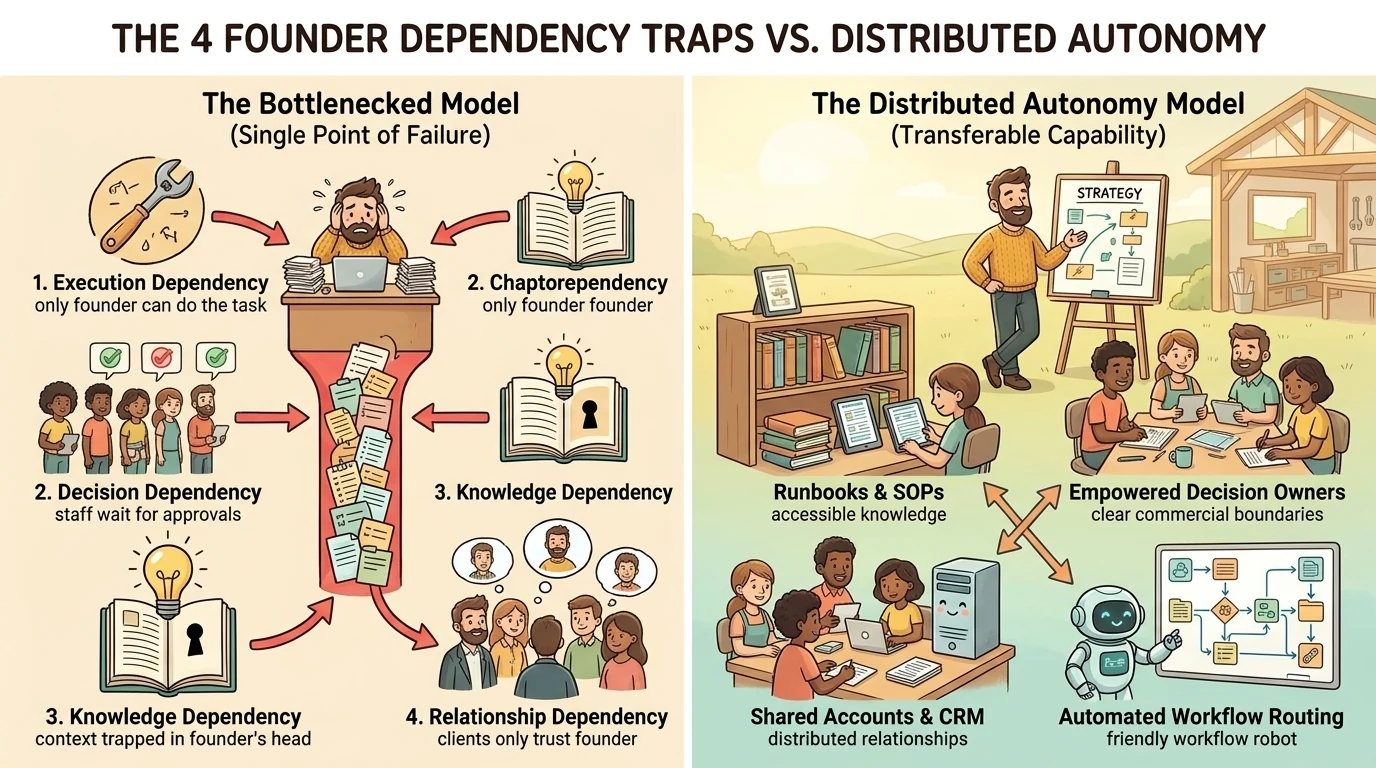
A useful distinction is:
- Execution dependency: only the founder can perform the work.
- Decision dependency: others can perform it, but cannot proceed without approval.
- Knowledge dependency: others have authority, but essential context exists only in the founder’s head.
- Relationship dependency: customers or partners trust the individual more than the organization.
These are diagnostic categories, not a standardized valuation model. Their purpose is to make dependency visible enough to address.
Working harder can temporarily conceal each one. It cannot eliminate them. Neither can simply giving the founder a more productive assistant. If Copilot helps the founder personally handle twice as many renewals, the bottleneck may become faster without becoming less central. If it helps an empowered account owner complete renewals without the founder, it supports organizational independence.
Why independence matters to value, without the multiple mythology
The economic argument is straightforward: a buyer wants earnings that can continue after ownership changes, not merely a record of what one exceptional person produced.
The Business Development Bank of Canada (BDC) identifies management strength, repeatable processes, the operating model, diversification, and financial performance as drivers of enterprise value. Its guidance also explains that value can improve through stronger cash flow or a lower risk profile. Founder independence fits within that broader picture; it is not the only determinant of value. Source: BDC, Enterprise value.
That distinction matters because a compelling operating argument can become a misleading financial claim.
There is no universal founder-dependency multiple
A simple story says that owner-operated businesses sell for two to three times earnings, professionally managed businesses for four to six times, and private-equity-backed businesses for six to eight times or more.
Those ranges should not be treated as universal rules. They do not establish how much of a valuation difference is caused by founder dependence rather than business size, sector, growth, customer concentration, earnings quality, or transaction conditions. BDC explicitly cautions that apparently comparable companies can differ in important ways, including scale. Source: BDC, Enterprise value.
There is also a denominator problem. Earnings before interest, taxes, depreciation, and amortization (EBITDA) is not interchangeable with seller’s discretionary earnings (SDE). In particular, an owner-operated earnings measure must not be compared with management-run earnings without accounting for the ongoing cost of replacing the owner’s operating work.
The International Business Brokers Association (IBBA) and M&A Source make the metric distinction explicit in their Q2 2025 Market Pulse highlights: transactions below $2 million are presented as multiples of SDE, while the $2 million–$50 million segments use EBITDA. This is a historical U.S. survey convention, not a global valuation rule or a current quote. Source: IBBA and M&A Source, Q2 2025 Market Pulse Highlights.
Comparing a small owner-operated company’s SDE multiple with a larger company’s EBITDA multiple does not isolate the price of founder dependence.
The arithmetic is useful only when the assumptions are visible
Consider a hypothetical company with $1 million of normalized annual EBITDA, after allowing for the management costs required to replace the founder’s operating work.
| Illustrative assumption | Implied enterprise value |
|---|---|
| $1 million EBITDA at 2.5× | $2.5 million |
| $1 million EBITDA at 4.5× | $4.5 million |
| Difference | $2 million |
This demonstrates the sensitivity of value to a multiple. It does not prove that hiring managers produces a two-turn increase.
If the original $1 million excluded replacement-management costs, the post-transition earnings base would need to be recalculated. Professionalization can improve resilience while initially reducing reported profit.
Nor is enterprise value the amount an owner takes home. In a simplified relationship, enterprise value equals equity value plus net debt; transaction-specific adjustments and costs also matter when estimating proceeds. Source: BDC, Enterprise value.
The defensible conclusion is narrower, and more useful: reducing founder dependence can strengthen the quality and transferability of earnings. The valuation effect requires company-specific evidence. Installing Copilot or deploying an agent is not evidence of a higher multiple. Sustained operating capability is the relevant outcome.
Start with a three-part value filter
Before redesigning the organization, examine what consumes its attention.
A useful starting point is the value question. For each project, process, hire, or initiative, ask:
- Does it increase sales?
- Does it improve profit?
- Does it build transferable value?
The third question is easy to overlook because its benefits may not appear immediately in monthly revenue.
A founder personally rescuing a renewal may protect sales. A documented renewal process, with an empowered account owner and clear commercial boundaries, may protect sales while also building a capability that survives the founder.
Prioritizing initiatives that satisfy at least two of the three questions can be a useful focus heuristic, not an absolute rule. Essential maintenance, legal obligations, and critical risk reduction should not be discarded because their contribution is indirect.
The sharper version of the filter asks what kind of sales, profit, and value the business is creating:
- Leveraged sales: growth that does not require proportionate increases in the founder’s effort.
- Cash-generating profit: earnings that translate into cash after the business’s operating and investment needs.
- Transferable value: capabilities, relationships, and systems that remain useful under different leadership.
“Cash-generating” does not mean all profit should be distributed. Reinvestment may be necessary and productive. The point is to distinguish accounting performance from cash availability, not to prescribe a payout policy.
Apply the same filter to technology. An agent that saves a few minutes but introduces another system only the founder can maintain may fail the transferability test. A modest knowledge assistant that helps a backup owner execute a critical process may be more valuable than an ambitious automation with unclear ownership.
Delegate decisions, not just tasks
A team can be busy and still have almost no autonomy.
“Handle renewals” is a task assignment. “You may approve renewals within these commercial boundaries” is a transfer of decision authority.
Use an own-and-escalate split:
- Name one accountable owner for a domain.
- Specify the decisions that owner can make.
- Define the conditions that require escalation.
- Provide the information and resources needed to act.
One accountable owner does not mean one isolated decision-maker. Finance, legal, delivery, and other specialists may still contribute. The objective is to remove ambiguity about who drives the outcome.
Example: client renewals
For an illustrative services business, a renewal owner might have authority to complete standard renewals using approved terms and pricing within a defined margin floor.
Escalation might be required when:
- Proposed pricing falls below that floor.
- The customer requests nonstandard contractual commitments.
- Delivery capacity cannot support the proposed scope.
- A material dispute or exposure exceeds the owner’s authority.
The owner should know where to escalate, not simply “ask the founder.” Routine exceptions can go to the relevant manager or specialist. Only genuinely reserved decisions need the founder’s involvement.
That is how independence becomes structural rather than theatrical.
Put the decision boundaries into the workflow
Once those rights exist, a Copilot Studio agent and a configured workflow can help make them operational. Microsoft documents agent flows with connector actions, branching, data operations, AI processing, and human-in-the-loop steps. These are implementation building blocks, not a prebuilt renewal solution. Source: Microsoft Learn, Agent flows overview.
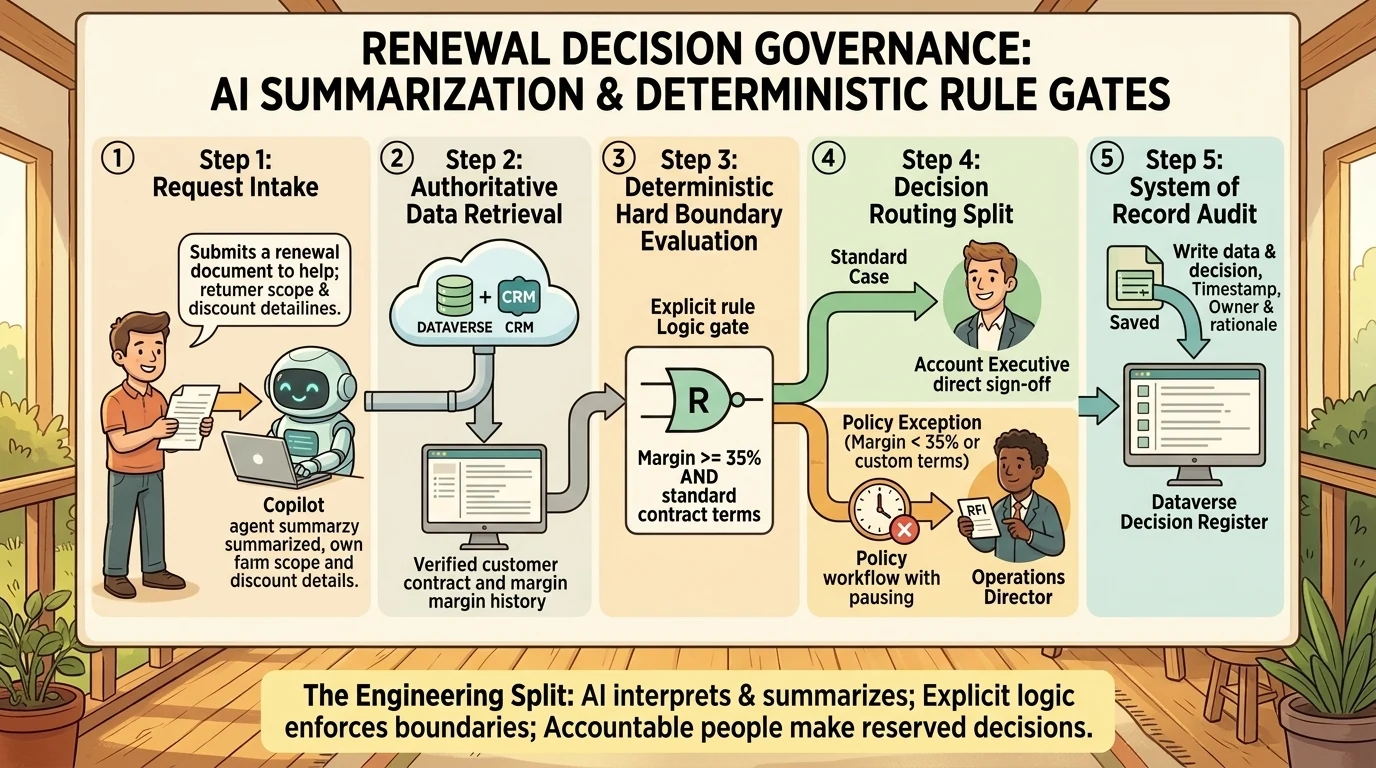
A proposed renewal design would work as follows:
- Collect the request. The employee supplies the customer, proposed scope, price, and requested changes. The agent helps gather missing inputs and prepares a concise summary.
- Retrieve authoritative data. Configured connector actions obtain the relevant customer and commercial records. Missing or stale data must trigger a defined exception, not a guessed answer.
- Evaluate hard boundaries. Explicit workflow logic checks required fields and approved thresholds. Margin calculations use validated numeric inputs and business-approved formulas, not a model’s narrative judgment.
- Route the case. Standard cases go to the renewal owner; defined exceptions go to the designated reviewer. Any external commitment remains behind the required human decision.
- Record the outcome. The configured workflow writes the decision, owner, exception reason, and timestamps to the chosen system of record.
The engineering split is deliberate: AI helps interpret and summarize; explicit logic enforces hard boundaries; accountable people make reserved decisions. Rule-based branching does not make an embedded AI-generated summary deterministic or necessarily correct.
This requires configured connections, appropriate access, a reliable source of commercial data, and tested exception handling. It is not achieved by adding “follow our margin policy” to an agent’s instructions. Nor should the knowledge agent described later be assumed to perform these transactional actions.
Measure decision turnaround, founder escalation rate, routing accuracy, and policy violations. A successful implementation removes unnecessary founder involvement without hiding exceptions or lowering decision quality.
Guardrails must be usable
A long approval chain can reflect uncertainty, but it is not automatically evidence of mistrust. Some decisions legitimately require multiple controls.
The better question is whether each approval has a defined purpose.
For every guardrail, specify:
- The trigger.
- The escalation recipient and backup.
- The expected response time.
- The safe action if a response is unavailable.
Autonomy without boundaries is exposure. Boundaries without authority are bureaucracy.
Mistakes are feedback, not permission to ignore consequences
A newly empowered manager may make a decision the founder would not have made. That alone does not establish failure.
Review the decision against the information available, the agreed boundaries, and the outcome. Was the judgment reasonable? Was the rule unclear? Was important context missing?
Some mistakes are an acceptable cost of learning. Others require immediate intervention. Delegation does not justify avoidable harm, contractual breaches, or uncontrolled losses.
The same principle applies to agent-assisted work. An incorrect summary or misrouted case is a reason to inspect sources, inputs, rules, and tests, not to assume the founder must resume every decision.
Make expertise transferable
Documentation is necessary, but a folder full of procedures is not proof of independence.
A transferable process should let someone understand the objective, execute the work, recognize exceptions, and teach another person to do the same.
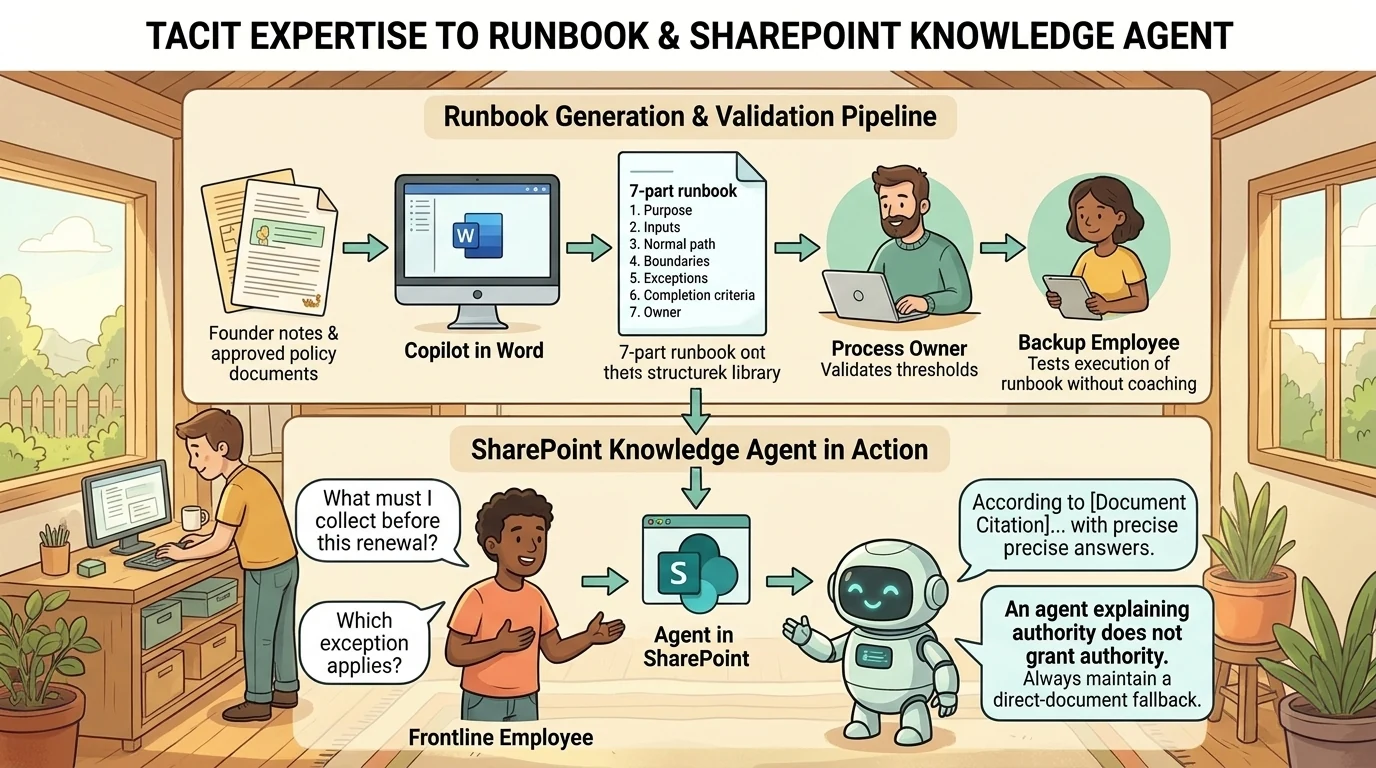
For a critical process, capture:
- Purpose: what outcome the process must produce.
- Inputs: the information, tools, and access required.
- Normal path: the usual sequence of actions.
- Decision boundaries: what the owner may decide independently.
- Exceptions: when and where to escalate.
- Completion criteria: how to recognize an acceptable result.
- Maintenance ownership: who keeps the process current.
This is closer to an operational runbook than a transcript of the founder’s habits.
The test is not “Did we write it down?” It is “Can someone use it without reconstructing the missing context through a conversation with the founder?”
BDC’s guidance supports the broader principle: reliable, repeatable processes help continuity, while stronger management capability supports enterprise value. Documentation alone, however, is not a guaranteed valuation premium. Source: BDC, Enterprise value.
Use Copilot to draft the runbook, not invent the process
Microsoft 365 Copilot in Word can draft from notes and reference files, refine existing content, and add structured material. Microsoft also explicitly instructs users to review and verify generated facts, numbers, citations, and policy statements. Availability depends on eligible licensing, organization settings, and the app experience. Source: Microsoft Support, Draft and add content with Copilot in Word.
For the renewal process, a practical knowledge-transfer exercise would be:
- Capture the founder’s explanation in notes, including unusual cases and the reasons behind past decisions.
- Gather the approved pricing policy, ownership record, and relevant process documents.
- Ask Copilot in Word to draft a runbook using those specific sources, separating documented rules from unresolved questions.
- Have the renewal owner validate the draft, particularly thresholds, contractual boundaries, and escalation recipients.
- Ask a backup employee to work through a sample renewal using the document without verbal coaching.
- Correct the gaps and publish the approved version with a named maintenance owner.
An illustrative drafting instruction could be:
Draft a renewal runbook from these notes and approved documents. Include required inputs, normal steps, decision authority, exceptions, and completion criteria. Do not invent thresholds or resolve conflicting policies. List missing information and contradictions separately for the process owner to review.
That instruction is a drafting aid, not a guarantee against unsupported output. Copilot cannot recover knowledge that was never captured, and a fluent document can still omit a critical exception.
Measure time to train a backup, founder interruptions during execution, and whether the backup completes the process correctly. Document volume is not the outcome.
Make the approved knowledge easy to use
Once the runbook is reliable, employees should not need the founder to locate or interpret it.
Agents in SharePoint can answer questions using sites, pages, and document libraries, with responses constrained by the user’s permissions to the underlying content. Microsoft documents both content-based answers and customizable knowledge scope. Sources: Microsoft Learn, Manage access to agents in SharePoint; Microsoft Support, Get started with agents in SharePoint.
A proposed renewal knowledge agent would use a maintained set of approved runbooks, ownership records, and policies. Employees could ask:
- “What must I collect before preparing this renewal?”
- “Which documented exception applies to this request?”
- “Who owns the next decision?”
Design and test it to point users to the supporting documents and to identify unresolved or conflicting guidance rather than improvise a rule. Keep draft and obsolete policies out of its intended knowledge scope. An employee who cannot access a necessary source may receive an incomplete answer; test the experience using the employee’s actual permissions, not only the maker’s account.
Access requires an eligible Copilot license or an organization-enabled pay-as-you-go arrangement; creating or editing an agent also requires the relevant site permissions. These prerequisites should be checked before choosing this pattern. Source: Microsoft Support, Get started with agents in SharePoint.
An agent explaining authority does not grant authority. It also does not replace the underlying runbook or the accountable process owner. Keep a direct-document fallback when the agent is unavailable or its answer is uncertain.
Measure questions resolved without founder involvement, incorrect answers, and documentation gaps. The objective is accessible organizational knowledge, not more chat activity.
Avoid moving the single point of failure
Replacing the founder with one indispensable operations manager is progress, but not complete resilience.
Similarly, the idea that four people performing at half the founder’s level automatically double capacity is too simplistic. Coordination, training, quality, and management overhead affect the result.
The objective is not arithmetic headcount substitution. It is accountable ownership, backup coverage, shared knowledge, and consistent execution.
Apply that standard to the technology too. If only the founder knows how to update the agent, repair its connections, or explain its rules, the dependency has moved rather than disappeared. Assign a business owner and a technical backup, document the configuration and recovery path, and test that someone else can maintain it.
Test independence instead of announcing it
An organization can appear autonomous while the founder quietly keeps it running through messages, approvals, and informal interventions.
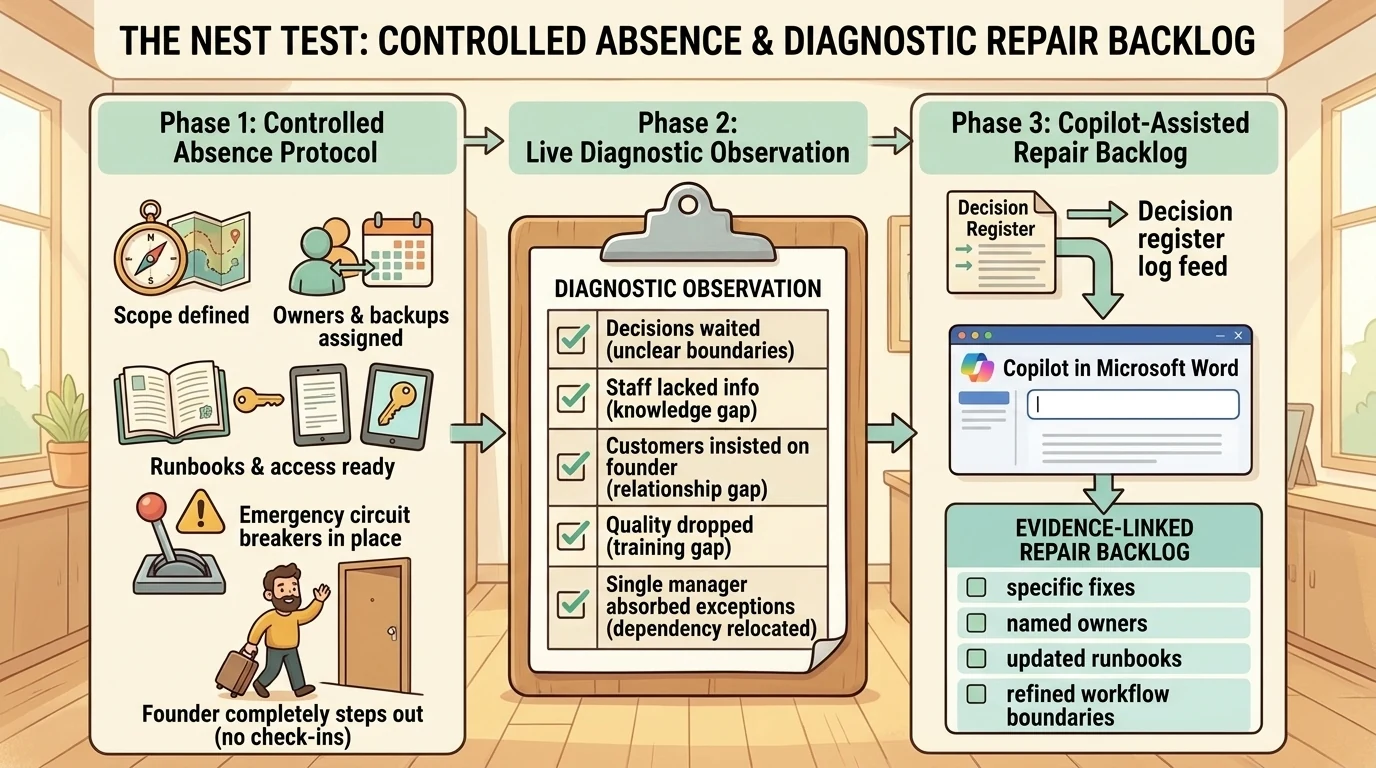
One practical exercise is the Nest Test: a period of founder absence used to expose hidden dependencies. Treat the name and duration as a practical framework, not an independently validated certification or industry standard.
A 72-hour absence can be a starting point. But three quiet days, especially over a weekend, may reveal little about monthly billing, major renewals, hiring, or cash management.
The test should cover meaningful operating activity, not merely elapsed time.
A controlled absence exercise
- Choose the scope. Identify the domains and decisions being tested.
- Assign ownership and backups. Confirm that people understand their authority.
- Prepare access and runbooks. Remove dependencies on the founder’s personal accounts or undocumented knowledge.
- Define emergency arrangements. Preserve necessary safety, legal, and business-continuity controls.
- Stop routine founder intervention. No ordinary approvals, coaching messages, or hidden check-ins.
- Record what happens. Capture decisions, delays, exceptions, and unresolved work.
- Review and improve. Repair the dependencies before extending the exercise.
This is not an instruction to become unreachable regardless of consequences. The experiment tests ordinary operating independence while retaining an appropriate emergency route.
Useful observations include:
| Observation | What it may reveal |
|---|---|
| Decisions waited for the founder | Missing authority or unclear boundaries |
| Staff could not find necessary information | Knowledge or access dependency |
| Customers insisted on founder involvement | Relationship dependency |
| Work continued, but quality deteriorated | Training or acceptance-criteria gaps |
| One manager absorbed every exception | Dependency relocated rather than removed |
| Problems were concealed until the founder returned | Weak reporting or unsafe escalation culture |
These are diagnostic signals, not automatic verdicts. A quiet test may mean the system worked, or that meaningful decisions were postponed.
Turn the test into a repair backlog
For the renewal example, extend the configured workflow to maintain a decision register: request identifier, accountable owner, decision time, exception reason, founder intervention, and final outcome. Connector and data-operation capabilities provide building blocks for recording such information, but the register and integrations must be implemented explicitly. Source: Microsoft Learn, Agent flows overview.
Include a way for employees to record work that stalled outside the automated path. Workflow logs alone cannot reveal every phone call, deferred decision, or informal workaround.
After the exercise, provide the validated register and team observations as reference material for a Copilot-assisted review document. Drafting from reference files is supported; identifying dependency themes and proposing a repair backlog is an illustrative use that still requires human verification. Source: Microsoft Support, Draft and add content with Copilot in Word.
Ask for evidence-linked findings: which cases waited, what information was missing, and which boundary needs clarification. Verify totals against the register rather than treating generated counts as authoritative. The useful output is a small set of specific fixes, each with an owner, not a polished declaration of independence.
Longer exercises can cover a week, a month, or a complete operating cycle as readiness permits. Duration is not the achievement. Sustained performance without routine founder intervention is.
Clarity × autonomy × transferable value
These ideas can be brought together in a Freedom Formula:
Clarity × autonomy × transferable value
This is a conceptual model, not a measurable financial equation. Its multiplicative form emphasizes that a severe weakness in one dimension can undermine the others.
- Clarity makes expectations, processes, and performance visible.
- Autonomy lets people act within understood boundaries.
- Transferable value allows the capability to survive a change of people or ownership.
Clear documentation without authority produces waiting. Authority without knowledge produces inconsistent judgment. A capable team without succession depth may still depend on a few irreplaceable individuals.
The model does not mean a business has literally zero value when one dimension is weak. It means that independence requires the dimensions to work together.
The renewal example follows the same logic. A reviewed runbook creates clarity. An empowered owner and explicit escalation path create autonomy. Backup coverage, maintained knowledge, and independently executed renewals demonstrate transferability. Copilot supports pieces of that system; it is not a fourth factor that compensates for missing ownership.
Exit readiness is evidence, not a score
A serious transfer discussion needs more than the founder’s assurance that the team can manage.
Useful evidence might include operating results during absence exercises, decision records, maintained runbooks, customer relationships shared across the team, and a management structure with real authority.
These are suggested artifacts, not a universal due-diligence checklist. Founder dependence belongs in a company-specific investigation rather than replacing the broader assessment of earnings, risk, and operating capability. BDC’s valuation guidance emphasizes professional judgment, expected cash flows, and the limitations of comparable transactions. Source: BDC, Enterprise value.
A readiness questionnaire can help start the conversation. It cannot independently establish a valuation discount or prove that a company is transferable. A score is only as useful as its methodology and the evidence behind the answers.
The same applies to an AI-generated readiness report. It may organize evidence; it must not turn incomplete records into a confident conclusion about valuation or independence.
Build options, not an obligation to sell
Independence can support a progression from operator to owner and, potentially, investor across several businesses.
That is a possible career path, not the required destination.
The claim that five exits at eight times annual profit produce “40 years of income” is an arithmetic analogy, not a return model. It leaves out the capital and time required to build each company, replacement-management costs, taxes, debt, transaction costs, failed ventures, and the earnings surrendered when an asset is sold.
Likewise, describing private equity as simply buying founder-dependent businesses cheaply and selling them at higher multiples is incomplete. It is a conceptual value-creation scenario, not a universal description of private-equity strategy or a guaranteed outcome.
A durable business may be worth keeping. Another owner may prefer succession, a partial sale, or a full exit. Independence makes those choices more credible; it does not determine which is best.
It can also improve the experience of ownership now. Fewer routine interruptions and less dependence on the founder can create room for strategy and personal time. But the transition has real costs: hiring, training, documentation, and temporary inefficiency. Exit readiness and quality of life can reinforce each other without being identical or free of trade-offs.
The first move: remove one dependency deliberately
Do not wait for a quarter in which nothing urgent happens. A growing business can always generate another reason to postpone the transition.
Start with five things that would stall if the founder were absent for a working week. For each, identify whether the missing ingredient is authority, knowledge, access, capability, or a relationship.
Then choose one domain with manageable risk:
- Assign an accountable owner and backup.
- Write the decision boundaries and escalation route.
- Transfer the necessary context and access.
- Observe independent execution.
- Fix the gaps before expanding the scope.
Where it removes real friction, use Copilot to help draft the runbook, a knowledge agent to make approved guidance accessible, or a configured workflow to route decisions and record outcomes. Do not build an agent where a clear document or simple rule-based workflow is sufficient.
The founder may still contribute unique judgment, strategic direction, or exceptional expertise. Independence does not require pretending that everyone is interchangeable. It requires distinguishing the contribution that is valuable from the dependency that is avoidable.
The goal is not to become irrelevant. It is to make your involvement a choice rather than a condition of the business continuing to work.
Read next