The Dawn of the Agent-Operated Enterprise: A Deep Dive into Microsoft 365 E7 and Copilot Wave 3

Writer
Quiz available
Take a quick quiz for this article.
For over a decade, Microsoft 365 E5 has sat unchallenged at the top of the enterprise licensing hierarchy. Launched in 2015, E5 has been the gold standard for organizations seeking to consolidate their productivity, security, and compliance stacks. However, the rapid proliferation of Generative AI has fundamentally changed the way enterprise IT operates.
The Core Shift: AI is transitioning from a passive chat assistant to an active, autonomous workforce—and managing that workforce requires an entirely new architecture.
On March 9, 2026, Microsoft officially responded to this shift by unveiling Microsoft 365 E7, subtitled “The Frontier Suite.” Officially reaching General Availability on May 1, 2026, E7 is priced at $99 per user, per month.
Simultaneously, Microsoft announced Microsoft 365 Copilot Wave 3, introducing true agentic, multi-step capabilities powered by a deep partnership with Anthropic.
But what exactly is E7? Is it a necessary evolution for IT governance and enterprise architecture? This comprehensive technical breakdown merges official announcements, licensing insights, and architectural deep-dives to explain exactly what this means for your tenant.
The Architecture of E7: The 4-in-1 “Frontier” Bundle
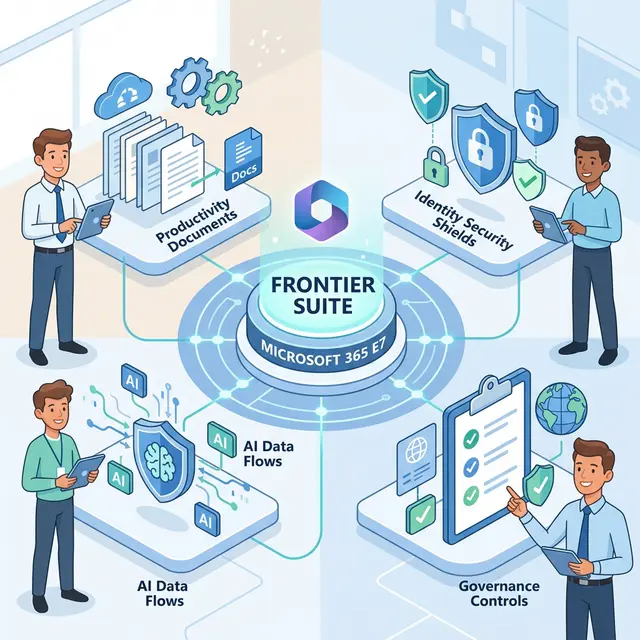
Microsoft 365 E7 is not just a productivity suite; it is a unified platform designed for a “human-led, agent-operated enterprise.” It is built on a foundation of what Microsoft calls Intelligence + Trust, bundling four major pillars into a single SKU.
Here is the exact breakdown of the E7 stack:
 (A conceptual breakdown of the four pillars that form the new Microsoft 365 Frontier Suite)
1. The Foundation: Microsoft 365 E5 (Unchanged)
E7 does not replace E5; it builds on top of it. Everything currently included in E5 carries forward completely unchanged. This is crucial for infrastructure teams—you do not need to rearchitect your existing deployments. You retain full access to:
- Productivity: Word, Excel, PowerPoint, Teams, SharePoint, Exchange Online (100GB mailboxes), and OneDrive (1TB+).
- Security (Defender XDR): Defender for Endpoint P2, Defender for Office 365 P2, and Microsoft Sentinel integrations.
- Compliance & Management: Microsoft Purview (DLP, eDiscovery, retention policies), Microsoft Intune, and PowerBI Pro.
- Identity base: Entra ID Plan 2 (Conditional Access, MFA, PIM).
2. The Identity Upgrade: Microsoft Entra Suite
A major component of the release is the inclusion of the full Microsoft Entra Suite (normally a $12/user/month add-on), representing a significant security enhancement. It modernizes network access and identity lifecycles by adding:
- Entra Private Access: A Zero Trust Network Access (ZTNA) solution that essentially acts as a modern VPN replacement, allowing granular, application-by-application access control rather than broad network tunneling.
- Entra Internet Access: Cloud-based web filtering and Secure Web Gateway (SWG) capabilities that route traffic safely through Microsoft’s global network.
- ID Governance: Automated workflows for the “joiner, mover, leaver” lifecycle. Access rights are dynamically provisioned or revoked based on HR triggers, eliminating IT ticket backlogs.
- Face Check with Verified ID: Decentralized, high-assurance identity verification using the Microsoft Authenticator app and device biometric cameras.
3. The Intelligence Layer: Copilot Wave 3 & Work IQ
Previously an independent $30/month add-on, Copilot is now natively embedded in the E7 suite. This includes the newly introduced Copilot Wave 3, which shifts from passive chat to true “agentic AI.”
- Copilot Cowork: Built in partnership with Anthropic (integrating Claude Cowork technology alongside OpenAI models), Copilot Cowork allows users to delegate complex, multi-step workflows. Instead of issuing single prompts, a user can ask Copilot to “analyze this Excel data, build a chart, draft a Word summary, and create a branded PowerPoint deck”—and Copilot will autonomously execute the steps across all those apps in a sandboxed cloud environment.
- Work IQ: This is Microsoft’s new foundational intelligence layer. It goes beyond simple Graph grounding. Work IQ ingests signals from Teams, SharePoint, and Outlook to construct a semantic graph of how you work, who you work with, and what projects are prioritized. It provides the deep contextual memory that prevents agents from hallucinating and ensures outputs align with internal corporate knowledge.
- In-App Agentic Drafting: Already rolling out as of March 9, 2026, Word can now iteratively build complete documents while asking the user clarifying questions about tone and audience. Excel has gained an “agent mode” capable of autonomous multi-step data analysis, and Outlook can automatically triage scheduling conflicts and draft complete agendas based on email threads.
The Work IQ Advantage: By providing deep contextual memory mapping how you interact with colleagues and projects, Work IQ aggressively reduces hallucinations and ensures Agentic behavior aligns with your internal corporate reality.
4. The Governance Control Plane: Microsoft Agent 365
This is a new control plane in the E7 suite. Priced standalone at $15/user/month and GA on May 1, Agent 365 addresses a key administrative requirement in the AI era: Shadow AI and Agent Governance.
AI agents are no longer just scripts; they are autonomous digital workers with real permissions, generating real blast radiuses. Agent 365 acts as the centralized IT administration dashboard to secure them:
- Agent Identity (Agent IDs): Through integration with Entra ID, every AI agent is assigned a unique non-human identity. This allows IT to manage agents just like human employees—assigning them sponsors, lifecycle expiration dates, and role-based access controls.
- Agent Registry & Observability: A centralized catalog that discovers both IT-sanctioned agents and “shadow agents” operating within the tenant.
- Security & Compliance: Agent 365 integrates with Defender XDR to detect anomalous agent behavior (e.g., data exfiltration attempts by a compromised agent) and utilizes Microsoft Purview to enforce strict Data Loss Prevention (DLP) policies on the content agents consume and generate.
- Integration Management: Enforces least-privilege access, ensuring a specific agent can only access the exact SharePoint sites or Model Context Protocol (MCP) servers it absolutely needs to function.
Managing agents through unique Agent IDs allows IT to treat digital workers exactly like human employees—enforcing strict lifecycles, role-based access, and direct accountability to an explicit human sponsor.
The Economics of E7: Cost and Component Breakdown
Microsoft’s pricing strategy for E7 is designed to make the transition financially logical for organizations already leaning into security and AI.
The Component Breakdown
If purchased separately, the stack looks like this:
- Microsoft 365 E5: $60/mo
- Microsoft 365 Copilot: $30/mo
- Microsoft Agent 365: $15/mo
- Microsoft Entra Suite: $12/mo
- Total Standalone Cost: $117 / user / month
At $99/user/month, E7 offers an $18/month saving off the standalone list prices. As Microsoft officially states, it is a comprehensive solution that offers up to 15% incremental savings when purchased as an integrated suite.
Note: Microsoft announced commercial price increases back in December 2025. Effective July 1, 2026, Microsoft 365 E3 is increasing from $36 to $39, and Microsoft 365 E5 is increasing from $57 to $60. By launching E7 on May 1, Microsoft provides a strategic alternative for enterprises facing this July 1 price hike. If an organization is already evaluating a baseline of E5 plus Copilot ($60 + $30 = $90), upgrading to the integrated E7 suite ($99/month) secures the Entra Suite and Agent 365 for just $9 more.
Governance vs. Creation: Understanding the Boundaries of E7
It is vital to understand that while the Microsoft 365 E7 license provides the ultimate administrative and productivity layer, it represents a specific half of the AI enterprise equation: Governance and Consumption.
Agent 365 is your control plane used to secure and govern digital workers, but it is not an agent builder. For the actual creation of custom, bespoke AI agents, organizations will leverage separate, specialized platforms like Microsoft Copilot Studio or Azure AI Foundry.
- Governance vs. Building: E7 gives you Copilot Wave 3 for your end-users and Agent 365 for your IT admins. However, if your development teams need to build standalone, custom applications, you will still utilize consumption-based or per-message licensing within Copilot Studio or Azure AI Foundry.
- Specialized Workloads: While E7 is comprehensive, certain highly specialized workloads remain separate. For example, advanced meeting security, end-to-end encryption, and the advanced Queues app are maintained under the Teams Premium license.
- Dedicated Security & Cloud: Microsoft Security Copilot, Teams Phone calling plans, Dynamics 365 applications, and pure Azure API consumption also remain distinct from the core M365 E7 productivity umbrella.
Strategic Implications: Should You Upgrade?
The decision to migrate to Microsoft 365 E7 depends on an organization’s current maturity model and AI adoption rates.
- The Integrated Scenario (E5 + Copilot + Entra Suite): If an organization is already paying for E5, Copilot, and the Entra Suite, the current spend is likely around $102/user. Upgrading to E7 consolidates these licenses and includes Agent 365 at a lower combined price point.
- The Security Expansion Scenario (E5 + Copilot): If currently utilizing E5 and Copilot ($90/user), E7 adds the full Entra Suite (ZTNA VPN replacement, ID governance) and Agent 365 for roughly $9 more. For security-conscious organizations, consolidating legacy VPN solutions via Entra Private Access often justifies the transition.
- The Evaluation Phase Scenario (E5 Only): If an organization is on E5 but has not yet fully deployed Copilot, acquiring E7 simply to drive adoption is rarely recommended. If users aren’t utilizing AI tools today, upgrading may result in underutilized licenses. Organizations should run pilots, measure active usage, and align training before upgrading.
- The Base E3 Scenario: Moving from $39/month (E3) to $99/month (E7) represents a significant financial commitment. These organizations should generally evaluate the security and compliance capabilities of E5 sequentially before adopting the complete Frontier Suite.
Final Thoughts
Microsoft 365 E7 is a clear signal that the era of “shadow AI experimentation” is ending. By introducing Agent IDs, Work IQ, and Copilot Cowork, Microsoft provides a framework where the enterprise treats AI not as a software feature, but as a digital workforce that requires the exact same level of identity management, conditional access, and zero-trust security as a human employee.
For CISOs and IT Directors, the release of E7 on May 1st provides the blueprint for how enterprise IT will look for the next decade. The destination is clear; the only question left is how quickly your organization is ready to make the journey.
Read next