Skill-Opt: Governance Playbook for Improving AI Agents

Writer

AI agents are leaving the demo stage and entering enterprise workflows. That changes the question.
It is no longer enough to ask, “Can this agent call a tool?” The better question is:
Can this agent improve safely, predictably, and economically without creating a new governance nightmare?
That is why SkillOpt from Microsoft Research is interesting. Not because it is another prompt trick. Not because it magically fixes agent reliability. It is interesting because it gives us a better mental model for governing agent behavior.
SkillOpt treats a plain-text skill document as the trainable state of a frozen AI agent. The model weights stay fixed. The agent’s operating instructions evolve through scored rollouts, reflection, bounded edits, and validation gates.
In simple terms:
SkillOpt turns prompt improvement into a controlled change-management process.
For IT leaders, FinOps practitioners, and tenant administrators, that framing matters. It moves the conversation away from “let developers keep tweaking prompts” and toward something much closer to operational governance:
- What changed?
- Why did it change?
- Was it validated before release?
- Can we inspect it?
- Can we roll it back?
- What is the cost of continuous improvement?
That is the real story.
The Mental Model: Stop Thinking “Prompt”, Start Thinking “Runbook”

Most organizations still treat prompts like fragile magic words. Someone writes a long instruction, tests a few happy paths, and ships it. Then the agent fails in production because the real world is messy.
A better analogy is this:
An agent skill document is not a prompt. It is an operational runbook for a digital worker.
A runbook tells people what to do when a system fails. A skill document tells an agent what to do when a task becomes ambiguous.
That shift immediately changes how you govern agents.
| Old Mental Model | Better Mental Model | Governance Implication |
|---|---|---|
| Prompt | Runbook | Treat changes as operational policy updates |
| Prompt tuning | Controlled optimization | Validate changes before promotion |
| Better wording | Better procedure | Measure task success, not style |
| One big instruction | Versioned skill artifact | Review, audit, compare, and roll back |
| Developer-owned prompt | Platform-owned behavior layer | Tenant admins and governance teams need visibility |
SkillOpt aligns well with this runbook model. The output is not an invisible model update. It is a human-readable Markdown file, typically exported as a reusable skill artifact. Microsoft Research describes SkillOpt as optimizing a skill file outside the frozen target model, using bounded edits and validation gating rather than changing model weights.
That is a big governance advantage.
When the thing that changes is text, you can inspect it. You can diff it. You can approve it. You can store it in source control. You can attach it to a change ticket. You can ask whether it violates policy.
Try doing that with 7 billion adjusted neural weights.
Why This Matters for Enterprise AI Governance
The enterprise agent failure mode is not usually dramatic. It is boring, expensive, and hard to see.
The agent loops. The agent repeats the same tool call. The agent searches the same source again and again. The agent uses more tokens than expected. The agent fails and retries. The workflow technically “runs”, but the business value leaks away through latency, consumption, and human cleanup.
That is where SkillOpt becomes strategically relevant.
It introduces four governance levers that IT leaders should care about:
| Governance Lever | What It Controls | Why Leaders Should Care |
|---|---|---|
| Rollouts | How the agent behaves on real or simulated tasks | Creates evidence before changing behavior |
| Reflection | How failures are analyzed | Turns incidents into reusable operating rules |
| Bounded edits | How much the skill can change at once | Prevents uncontrolled prompt drift |
| Validation gates | Whether a candidate skill is accepted | Stops “reasonable-sounding” changes from reducing performance |
Think of it as change advisory board discipline for agent instructions, but automated around measurable task outcomes.
How SkillOpt Works, Without the Academic Fog
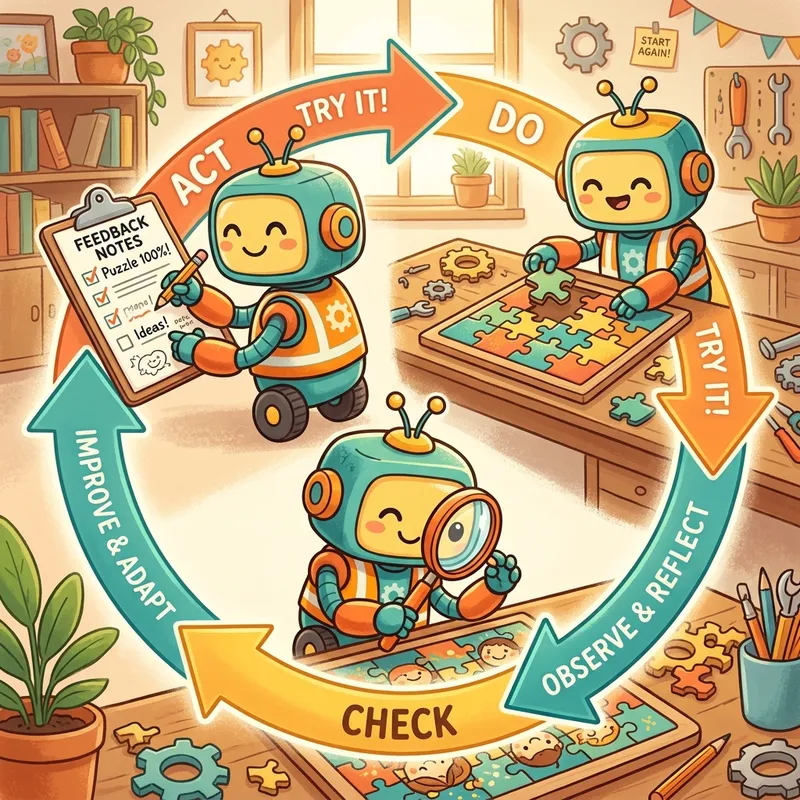
SkillOpt borrows the discipline of deep-learning training but applies it to text.
The target model does not learn in the neural-weight sense. Instead, the skill document learns.
Here is the practical loop:
- Run the agent against tasks. The current skill document is used as the agent’s guidance.
- Collect the evidence. Successes, failures, tool calls, verifier feedback, and task metadata are captured.
- Ask an optimizer model to review the evidence. The optimizer proposes specific add, delete, or replace edits to the skill document.
- Limit the blast radius. Only a bounded number of edits can be applied in one step.
- Test the candidate skill on validation tasks. If performance improves, keep the change. If not, reject it.
- Export the best skill. The result is a deployable Markdown artifact, not a retrained model.
The deep-learning analogy is useful, but only if we translate it into operational language.
| Deep Learning Concept | SkillOpt Equivalent | Enterprise Translation |
|---|---|---|
| Model weights | Skill document | The agent’s governed operating procedure |
| Forward pass | Rollout | Run the workflow and observe behavior |
| Loss or score | Task evaluator | Did the business task succeed? |
| Backpropagation | Reflection | Analyze why the agent failed |
| Learning rate | Edit budget | Limit how much behavior can change |
| Validation set | Held-out tasks | Test before promotion |
| Rejected update | Rejected edit buffer | Learn from failed proposed changes |
| Momentum | Slow update | Preserve proven rules across cycles |
This is the part I like most: SkillOpt makes agent improvement look less like prompt hacking and more like release management.
Two epoch-level ideas are worth calling out because they matter for governance:
- Slow update is the stabilizer. It helps preserve rules that have proven useful across optimization cycles, instead of letting the latest batch of failures rewrite the whole operating procedure.
- Meta skill is the optimizer’s memory. It captures which kinds of edits tend to work over time, so the optimizer does not keep rediscovering the same lessons from scratch.
For leaders, the takeaway is simple: this is not just “generate a better prompt.” It is a feedback system with memory, acceptance criteria, and blast-radius control.
The FinOps Angle: Improvement Has a Cost Curve

SkillOpt does not fine-tune model weights, so it avoids the cost and operational complexity of traditional training. But it is not free.
You still pay for inference during rollouts, optimizer calls, validation runs, log storage, and engineering time. If you run locally, you pay through GPU depreciation, power, storage, and operational maintenance. If you use hosted models, you pay through token consumption.
The right mental model is:
SkillOpt moves cost from model training to controlled evaluation.
That can be a good trade, but only if you govern it.
Directional Planning Math, Not a Quote
The following is a planning aid, not official pricing. Actual cost depends on provider, model, region, discounts, prompt sizes, output lengths, and how many failed attempts you generate.
Imagine one optimization cycle:
| Input | Directional Assumption |
|---|---|
| Rollout tasks | 1,000 tasks |
| Average target-model tokens per task | 4,000 tokens |
| Optimizer and reflection overhead | 1,500 tokens per task equivalent |
| Validation reruns | 300 tasks at 4,000 tokens |
| Total rough tokens | Around 6.7 million tokens |
If your all-in blended inference price were $0.10 per 1 million tokens, that cycle is roughly $0.67 in model usage.
If your blended price were $2.00 per 1 million tokens, the same cycle is roughly $13.40.
If you scale to 100,000 rollout tasks, the curve changes quickly:
| Scenario | Rough Token Volume | At $0.10 / 1M Tokens | At $2.00 / 1M Tokens |
|---|---|---|---|
| Small lab test | 6.7M | ~$0.67 | ~$13.40 |
| Department pilot | 67M | ~$6.70 | ~$134 |
| Large benchmark run | 670M | ~$67 | ~$1,340 |
Again, do not treat these as quotes. Treat them as a way to build intuition.
The important FinOps point is this:
The cost driver is not SkillOpt itself. The cost driver is how aggressively you run evidence collection and validation.
That means your governance controls should focus on task volume, token budgets, logging retention, validation frequency, and model routing.
Platform Routing: Do Not Use a Race Car for Every Delivery
SkillOpt separates two roles:
| Role | What It Does | Routing Strategy |
|---|---|---|
| Target model | Executes the task using the current skill | Use the model you expect to run in production or a close substitute |
| Optimizer model | Reviews trajectories and proposes edits | Use a model strong enough to reason over failures and propose useful patches |
This separation creates a practical cost lever.
You do not always need your most expensive model for every part of the loop. For example:
- Use a smaller or local target model for early experimentation.
- Use a stronger optimizer model only when failure analysis requires deeper reasoning.
- Use a hosted model for optimizer quality, but keep rollouts local when data sensitivity or cost requires it.
- Route production-like validation through the same model family used in deployment.
This is not just an engineering choice. It is a FinOps control.
| Decision | Cost Impact | Governance Question |
|---|---|---|
| Bigger rollout batch | Higher token and log cost | Do we need more evidence, or are we past diminishing returns? |
| Stronger optimizer model | Higher reflection cost | Are failures complex enough to justify it? |
| More epochs | Higher repeated evaluation cost | Are scores still improving meaningfully? |
| Hosted inference | Variable token cost | Are budgets and chargeback tags applied? |
| Local inference | Fixed infrastructure cost | Is GPU utilization high enough to justify ownership? |
A useful rule of thumb:
Use cheap evidence collection, strong failure analysis, and strict validation.
That is the balance most enterprises should aim for.
Hands-On Experience: What a Practical Pilot Looks Like
The improved article should not become a command-line manual, but it also should not stay theoretical. A useful SkillOpt pilot has a very practical shape.
In the original lab-style setup, the pattern was roughly:
- Run a local model behind an OpenAI-compatible endpoint.
- Use SkillOpt to execute batches of benchmark tasks.
- Capture trajectories, including successful actions, failed actions, tool calls, and final scores.
- Let the optimizer model propose edits to the skill document.
- Accept only changes that improve held-out validation performance.
- Inspect the final Markdown skill before thinking about production use.
That is the part worth preserving. The exact hardware and model configuration can vary.
A Generalized Lab Pattern
Rather than hard-coding one hardware recipe as if it were universal, think in terms of a lab pattern:
| Lab Component | Practical Guidance |
|---|---|
| Operating environment | Use a reproducible Linux-based environment if possible, especially for GPU serving and benchmark runs. |
| GPU capacity | Size for the selected model, quantization method, context length, batch size, and KV-cache behavior. Do not assume one VRAM number applies everywhere. |
| Serving layer | Use a model-serving layer that exposes an OpenAI-compatible API if you want easier routing between local and hosted models. |
| Target model | Start with a smaller model for early validation, then test against something closer to the intended production model. |
| Optimizer model | Use a model strong enough to reason over failures and propose useful edits. This can be local, hosted, or hybrid depending on cost and data constraints. |
| Logs and traces | Treat rollout logs as potentially sensitive and potentially large. Set storage limits before the run starts. |
| Validation set | Keep a held-out set that the optimizer does not directly tune against. This is your promotion gate. |
A Minimal Configuration Example
For readers who want the shape of the setup without turning the article into a full reproduction guide, this is enough:
The exact variable names depend on the framework, wrapper, and SkillOpt configuration being used. The strategic point is that the optimizer and target model should be routed intentionally, not accidentally.
What We Learned from the Lab Pattern
A few practical lessons are worth making explicit:
- Storage can fail before the model does. Continuous trajectory logging is useful, but it can grow quickly. Put a retention policy in place before running large batches.
- VRAM usage is workload-dependent. Model size is only one part of the equation. Context length, KV cache, quantization, concurrency, and batch size can dominate real memory behavior.
- Small test runs are valuable. A one-epoch or small-batch smoke test is not meant to prove business value. It proves that the loop works end to end.
- Do not confuse benchmark success with production readiness. ALFWorld-style tasks are useful because they expose repeated-action failures, but production workflows still need business-specific validators.
- Inspect the skill artifact. The best part of this pattern is that the output is readable. Use that advantage.
Local Inference with vLLM: Useful, but Do Not Oversell It
vLLM can expose local models through an OpenAI-compatible server, which makes it useful for controlled experimentation and routing flexibility. Qwen-family 4B models are a reasonable example of the kind of smaller model teams may use for local tests, but the exact model choice should follow the workload, licensing, hardware, and governance requirements.
Local experimentation is attractive when you want cost control, data locality, or repeatable benchmarking. But local does not automatically mean cheaper.
Local inference can be a great fit when:
- You have sustained utilization.
- You need data locality for sensitive evaluation traces.
- You want predictable capacity for benchmarking.
- You already operate GPU infrastructure.
- You can manage patching, drivers, monitoring, and storage.
Hosted inference can be a better fit when:
- Usage is spiky.
- You need rapid experimentation across model families.
- Your team does not want to own GPU operations.
- You need enterprise billing, quota, and regional controls from a managed provider.
| Option | Strength | Risk |
|---|---|---|
| Local serving | Control, locality, predictable experimentation | GPU underutilization, operational burden, storage growth |
| Hosted API | Elasticity, fast model choice, easier operations | Token spend sprawl, data residency review, provider lock-in |
| Hybrid | Cost-aware routing with governance flexibility | More platform complexity |
My recommendation: start with the routing model before arguing about the runtime.
If the governance architecture is weak, both local and hosted deployments can become expensive. Local just hides the bill in infrastructure. Hosted puts it on the consumption report.
The Admin Control Plane: What Tenant Owners Should Care About
Tenant administrators may not care about the internals of text-space optimization, but they absolutely should care about who can run it and where the resulting skills go.
A SkillOpt-style process creates a new class of artifact: continuously improved behavioral instructions. That artifact needs a lifecycle.
| Control Area | Admin Question | Recommended Control |
|---|---|---|
| Ownership | Who owns the skill document? | Assign product owner and technical owner |
| Approval | Who can promote a skill to production? | Require review for high-impact workflows |
| Scope | Which agents can use this skill? | Bind skills to specific environments and use cases |
| Data | What trajectories are logged? | Classify logs as potentially sensitive |
| Cost | Who pays for rollouts and optimizer calls? | Tag runs by workload, team, and cost center |
| Rollback | Can we restore the previous version? | Store versioned artifacts and validation scores |
| Audit | Can we explain why behavior changed? | Preserve diffs, rejected edits, and evaluation summaries |
This is where many agent programs underinvest.
They govern the model. They govern the connector. They govern access to data. But they forget to govern the instruction layer that actually shapes day-to-day behavior.
That is a mistake.
Safe Rollout Pattern for Enterprises

If I were advising an enterprise team, I would not start with “run SkillOpt on everything.” I would use a staged rollout.
Phase 1: Lab Benchmark
Pick a narrow workflow where success can be scored.
Good examples:
- Classifying support tickets.
- Extracting fields from standardized documents.
- Performing spreadsheet transformations.
- Navigating a known tool workflow.
- Answering questions from a controlled knowledge base.
Avoid starting with open-ended executive assistants or broad autonomous agents. They are too hard to score cleanly.
Phase 2: Cost-Bounded Pilot
Set explicit limits before running optimization:
| Limit | Example |
|---|---|
| Maximum rollout tasks | 1,000 tasks |
| Maximum epochs | 2 to 4 epochs |
| Maximum tokens | Fixed budget per run |
| Maximum edit budget | Small bounded changes per step |
| Log retention | Short retention unless legally required |
| Promotion rule | Validation improvement required |
This prevents the classic AI pilot problem: nobody knows whether the experiment succeeded, but everyone knows it consumed budget.
Phase 3: Human Review Before Production
SkillOpt can propose edits, but production promotion should be governed.
Reviewers should ask:
- Did validation improve on held-out cases?
- Did any new instruction create policy risk?
- Did the skill become too long or too specific?
- Are there signs of benchmark overfitting?
- Is the new behavior explainable to the business owner?
Do not approve a skill just because the text sounds smarter. Approve it because the evidence improved.
Phase 4: Production Monitoring
After deployment, monitor:
- Task success rate.
- Retry loops.
- Tool-call volume.
- Token usage per completed task.
- Human escalation rate.
- User satisfaction or correction rate.
- Cost per successful outcome.
That last metric matters.
The goal is not cheaper tokens. The goal is cheaper successful outcomes.
An agent that uses 20 percent more tokens but reduces human escalations by 50 percent may be a bargain. An agent that uses fewer tokens but fails silently is not.
What an Evolved Skill Document Looks Like
The original example used ALFWorld, a simulated text-based home environment where agents perform household tasks like finding, cleaning, and placing objects.
This may sound toy-like, but it exposes a very real enterprise pattern: agents often fail because they repeat unproductive actions.
In ALFWorld, that might look like:
In business systems, the equivalent failure looks like:
Or:
An optimized skill document might be organized by task pattern, for example:
| Skill Section | Example Rule Pattern | Enterprise Equivalent |
|---|---|---|
| Pick-and-place style tasks | Find the object, verify it, move it, then confirm completion | Retrieve a record, validate it, update the system, then confirm status |
| Clean-and-place style tasks | Prepare the object before placing it in the target location | Normalize data before loading it into the destination system |
| Search and recovery tasks | Search each location only once unless new evidence appears | Avoid repeating the same knowledge-base or CRM lookup without changing the query |
| Object-specific guidance | Preserve tested handling tips for recurring objects or tools | Preserve workflow-specific rules for invoices, tickets, contracts, or customer records |
An optimized skill document might add rules such as:
- Search each location only once unless new evidence appears.
- If a lookup returns no result, broaden the query instead of repeating it.
- Keep a short memory of failed attempts within the task.
- Stop after a defined number of unsuccessful retries and escalate.
- Prefer verified tool output over model guesses.
- Preserve narrow, tested tips when they repeatedly improve outcomes, but remove them if they become stale or overly specific.
Those rules are not glamorous. They are operationally valuable.
They reduce loops. They reduce token waste. They reduce latency. They make behavior easier to explain.
Legacy Prompting vs. SkillOpt-Style Governance
| Dimension | Legacy Prompt Iteration | SkillOpt-Style Optimization |
|---|---|---|
| Change method | Manual edits based on intuition | Evidence-driven edits from scored trajectories |
| Validation | Often informal | Held-out validation gate |
| Cost visibility | Usually weak | Can be tracked per run, batch, epoch, and task |
| Auditability | Depends on discipline | Skill artifact and diffs are inspectable |
| Risk of drift | High if prompts keep growing | Reduced through bounded edits and rejected-edit learning |
| Production fit | Good for prototypes | Better aligned to governed agent operations |
This is why leaders should pay attention. SkillOpt is not only a research technique. It is a pattern for making agent behavior more governable.
Common Failure Modes to Watch
SkillOpt does not remove the need for judgment. It simply gives you a better loop.
Watch for these risks:
| Failure Mode | What Happens | Mitigation |
|---|---|---|
| Overfitting to benchmark tasks | Skill improves in lab but fails in production | Use diverse validation sets and production telemetry |
| Skill bloat | Document becomes too long and expensive | Enforce length budgets and remove stale rules |
| Hidden data leakage | Logs contain sensitive content | Apply data classification and retention controls |
| Weak evaluator | Optimization improves the wrong metric | Align scoring with business outcomes |
| Excessive experimentation | Teams run too many cycles without value | Set budgets, owners, and stop criteria |
| Unreviewed promotion | Optimized skill changes production behavior unexpectedly | Require approval for high-impact workflows |
The evaluator is especially important.
If the score rewards the wrong thing, optimization will faithfully improve the wrong thing.
That is not a SkillOpt problem. That is a governance problem.
Decision Guide: When Should You Use This Pattern?
Use SkillOpt-style optimization when:
- The workflow has repeatable tasks.
- Success can be scored objectively.
- Agent failures are expensive or frequent.
- Instructions need to remain auditable.
- You want improvement without model fine-tuning.
- You need a governed path from pilot to production.
Be cautious when:
- The task is highly subjective.
- You cannot define a reliable evaluator.
- Logs may contain sensitive data you cannot safely retain.
- The agent has broad authority across systems.
- You are optimizing before you understand business value.
A simple rule:
If you cannot measure success, do not automate self-improvement yet.
Start by building the evaluator.
Practical Governance Checklist
Before running a SkillOpt-style process, answer these questions:
| Question | Why It Matters |
|---|---|
| What business outcome are we improving? | Prevents optimization theater |
| What is the scoring method? | Defines what “better” means |
| What is the token and infrastructure budget? | Prevents runaway evaluation cost |
| What data is captured in trajectories? | Controls privacy and compliance risk |
| Who can approve skill promotion? | Establishes accountability |
| Where are skill versions stored? | Enables audit and rollback |
| What is the rollback trigger? | Reduces production risk |
| How do we measure cost per successful outcome? | Links AI spend to business value |
This is the difference between an exciting demo and an operating model.
My Take
SkillOpt is valuable because it challenges one of the worst habits in enterprise AI: treating prompts as disposable text blobs.
For simple demos, that may be fine. For enterprise agents, it is not.
Agent instructions are becoming a control surface. They determine how tools are used, how errors are handled, how costs accumulate, and when work is escalated to humans.
SkillOpt gives us a disciplined way to improve that control surface:
- Keep the model frozen.
- Improve the skill artifact.
- Bound the changes.
- Validate before accepting.
- Export something humans can inspect.
That is the pattern worth remembering.
Not every organization needs to run SkillOpt tomorrow. But every organization building AI agents should adopt the underlying philosophy:
Treat agent behavior as a governed asset, not a prompt-writing side quest.
References
- Microsoft Research, “SkillOpt: Agent skills as trainable parameters” (June 30, 2026): https://www.microsoft.com/en-us/research/blog/skillopt-agent-skills-as-trainable-parameters/
- SkillOpt project page: https://microsoft.github.io/SkillOpt/
- SkillOpt documentation and reproduction guide: https://microsoft.github.io/SkillOpt/docs/guideline.html
- SkillOpt arXiv paper: https://arxiv.org/abs/2605.23904
- SkillOpt GitHub repository: https://github.com/microsoft/SkillOpt
- vLLM OpenAI-compatible server documentation: https://docs.vllm.ai/en/stable/serving/online_serving/openai_compatible_server/
- Qwen3-4B model card on Hugging Face: https://huggingface.co/Qwen/Qwen3-4B
Read next