Microsoft Contact Center Intelligence: Voice and Chat AI Without Replacing Your Platform

Writer

A customer calls a bank to ask about a travel credit card. The interactive voice response system hears “credit card” and sends them toward payments. The customer corrects it. The system repeats the same menu.
The problem is not that the bank lacks a telephone system. It is that the conversation cannot move beyond the categories its designers anticipated.
Replacing the entire contact center might solve that problem, but it also introduces decisions about telephony, routing, queues, agent desktops, integrations, and operational change. Those systems may still work perfectly well. Why should improving the conversation require replacing all of them?
Microsoft Contact Center Intelligence (CCI) separates those decisions. It brings conversational agents, authentication, quality assurance, and operational insights into an existing contact center, while allowing the underlying platform to remain in place.
That is the central architectural idea: modernize how customers are understood and served without making a full platform migration the prerequisite.
What CCI Is, and What It Is Not
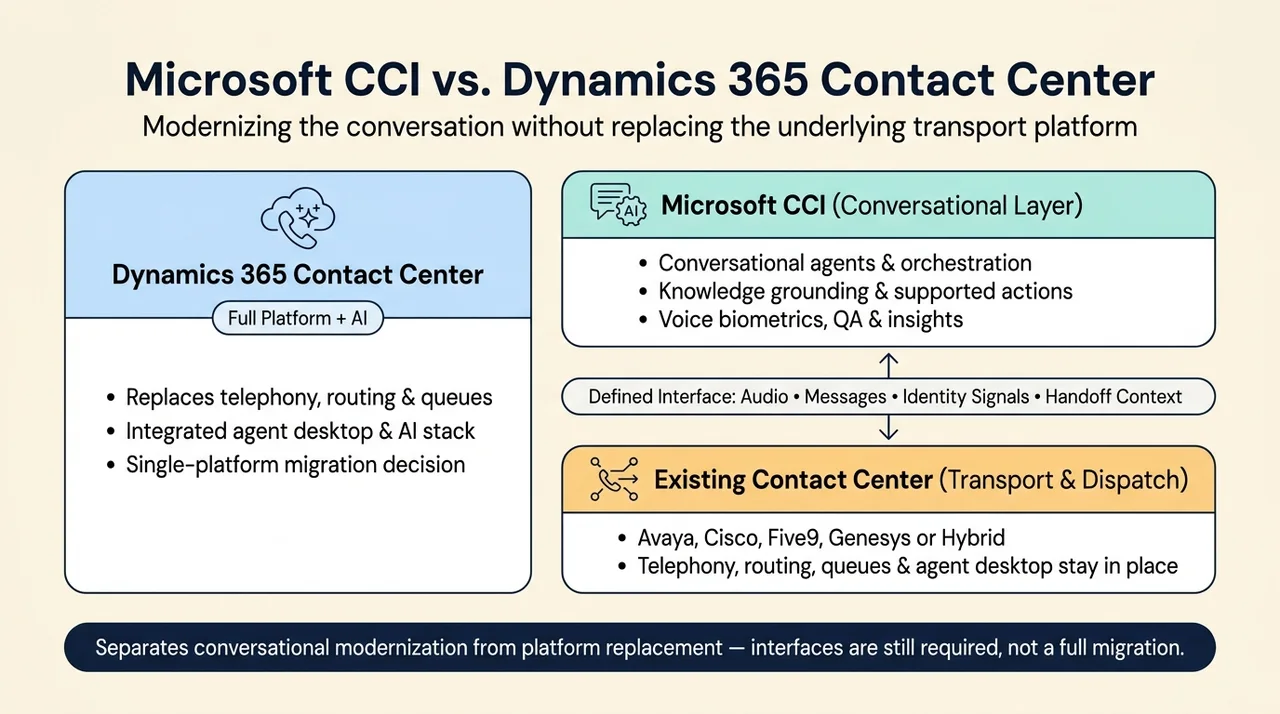
Microsoft describes CCI as an intelligent layer that complements existing telephony, routing, queues, and representative engagement. It works with Dynamics 365 Contact Center, third-party Contact Center as a Service (CCaaS) platforms (such as Genesys, Avaya, Cisco, or Five9), and hybrid setups where telephony, routing, and AI span multiple systems. To integrate with them, CCI uses supported partner integrations, pre-built or universal connectors, application programming interfaces (APIs), event streams, and embedded desktop experiences. See the official CCI overview.
The distinction between CCI and Dynamics 365 Contact Center matters:
- Dynamics 365 Contact Center provides the contact center platform and its integrated AI capabilities.
- CCI makes Microsoft’s conversational intelligence capabilities available alongside an existing contact center, including a third-party platform.
Think of the existing contact center as the transport and dispatch system. It receives calls, manages queues, and connects customers to representatives. CCI adds a conversational service layer that can understand requests, consult knowledge, execute supported actions, and decide when a person should take over.
The analogy has a boundary: this is not an invisible overlay that requires no integration. Audio, messages, identity signals, and handoff context still have to cross a defined interface. The advantage is that those interfaces can be established without replacing the entire operational platform.
Availability: the product is generally available (GA), but not every integration is
Availability context: Microsoft introduced CCI in public preview on October 21, 2026, and published its general availability announcement on November 18, 2026. This article reflects documentation available on November 20, 2026. General availability applies to the product, not automatically to every connector, model, or integration path—for example, the documented Genesys AudioHook voice biometrics integration is still explicitly marked preview.
That distinction prevents a common mistake: treating a launch announcement as a blanket production-readiness statement for everything shown on stage.
The Conversation Harness: More Than an LLM Answering Calls
A large language model (LLM) can generate a response. A contact center needs a system that can manage an interaction.
It must understand the customer’s intent, select the right specialist, retrieve relevant information, invoke tools, follow required procedures, maintain context, and transfer control when appropriate. In voice, it must also manage speech and turn-taking.
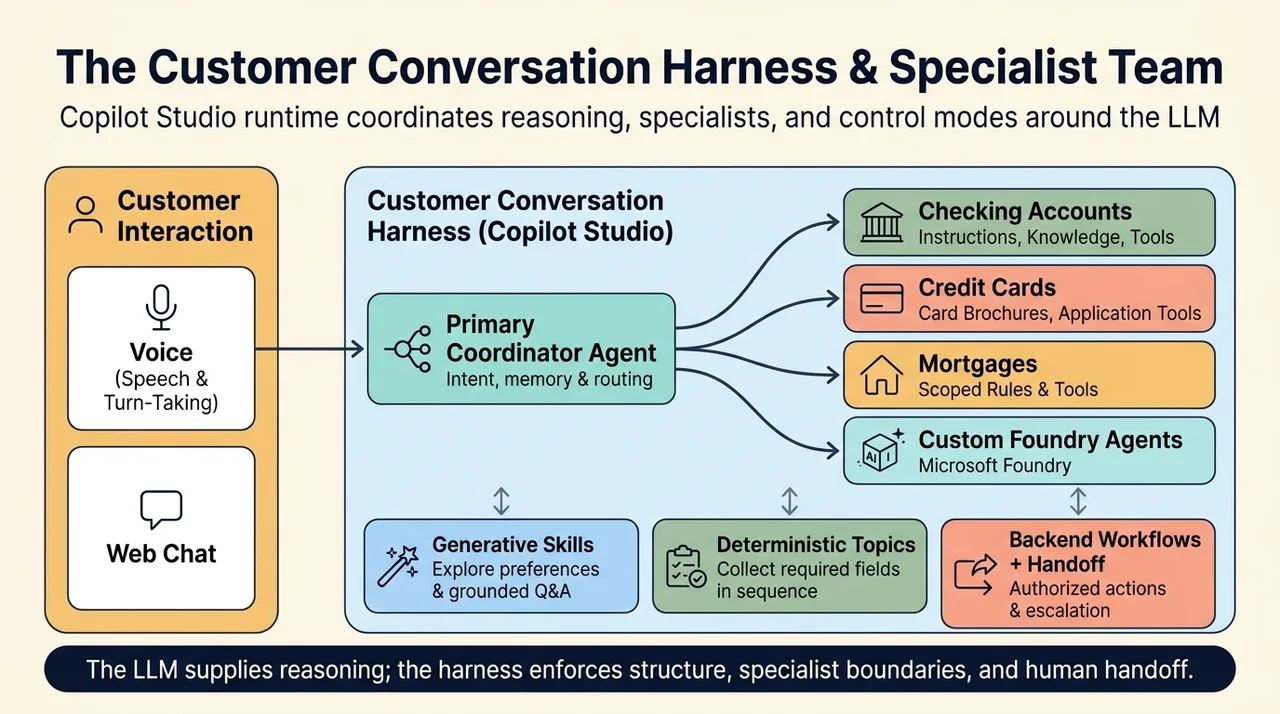
CCI’s conversational agent builder uses the customer conversation harness introduced in Microsoft Copilot Studio. Here, a harness means the runtime and orchestration capabilities around the model, not the model itself. Microsoft’s harness announcement describes multi-agent orchestration, generative skills, deterministic topics, voice and chat support, memory, and human handoff.
This is a useful mental model: the model supplies language and reasoning capabilities; the harness organizes those capabilities into a customer-service experience.
A team of specialists, not one giant prompt
In the banking demonstration presented at Ignite, a primary agent coordinated specialist sub-agents for checking accounts, credit cards, and mortgages. Each specialist had its own instructions, knowledge, and tools.
Microsoft’s GA announcement confirms this multi-agent architecture and the ability to add custom agents built in Microsoft Foundry to the team.
The benefit is separation of responsibilities. A credit card specialist can work with card brochures and application tools without requiring the mortgage specialist to carry the same instructions. The customer experiences one service conversation, while the system organizes work behind the scenes.
This does not remove the need for design. Teams still need to define specialist boundaries, escalation rules, tool permissions, and what happens when a request spans several domains. Natural-language authoring can accelerate an initial design; it cannot establish the correctness of that design by itself.
Generative Where Helpful, Deterministic Where Necessary
One of CCI’s most important capabilities is the ability to combine generative skills and deterministic conversational topics within the same agent.
These are different kinds of control:
| Interaction | Appropriate control | Why |
|---|---|---|
| Explore travel preferences | Generative dialogue | Customers describe needs in varied, unpredictable ways. |
| Explain card benefits | Generative response grounded in approved knowledge | The wording can vary, but the facts should come from authoritative material. |
| Collect required application information | Deterministic topic | Required fields and sequencing need explicit control. |
| Execute a financial transaction | Controlled workflow with backend authorization | A conversational request must not bypass transaction rules. |
| Request an exception such as a fee waiver | Defined escalation or approval path | The agent should not invent authority to grant an exception. |
Microsoft documents this hybrid approach in both the CCI GA announcement and the customer conversation harness announcement.
The banking example makes the distinction concrete. Recommending a card can involve open-ended questions about lounge access, annual fees, and travel benefits. Applying for that card should follow a controlled process. Asking for a fee waiver may require a human specialist.
A deterministic topic controls the conversational path. It does not, by itself, guarantee that the backend action is authorized, valid, or completed successfully. Those checks still belong in the business system and its integration.
The goal is not to make every interaction generative. It is to put flexibility and control in the right places.
One Agent Across Voice and Chat, With Channel-Aware Behavior
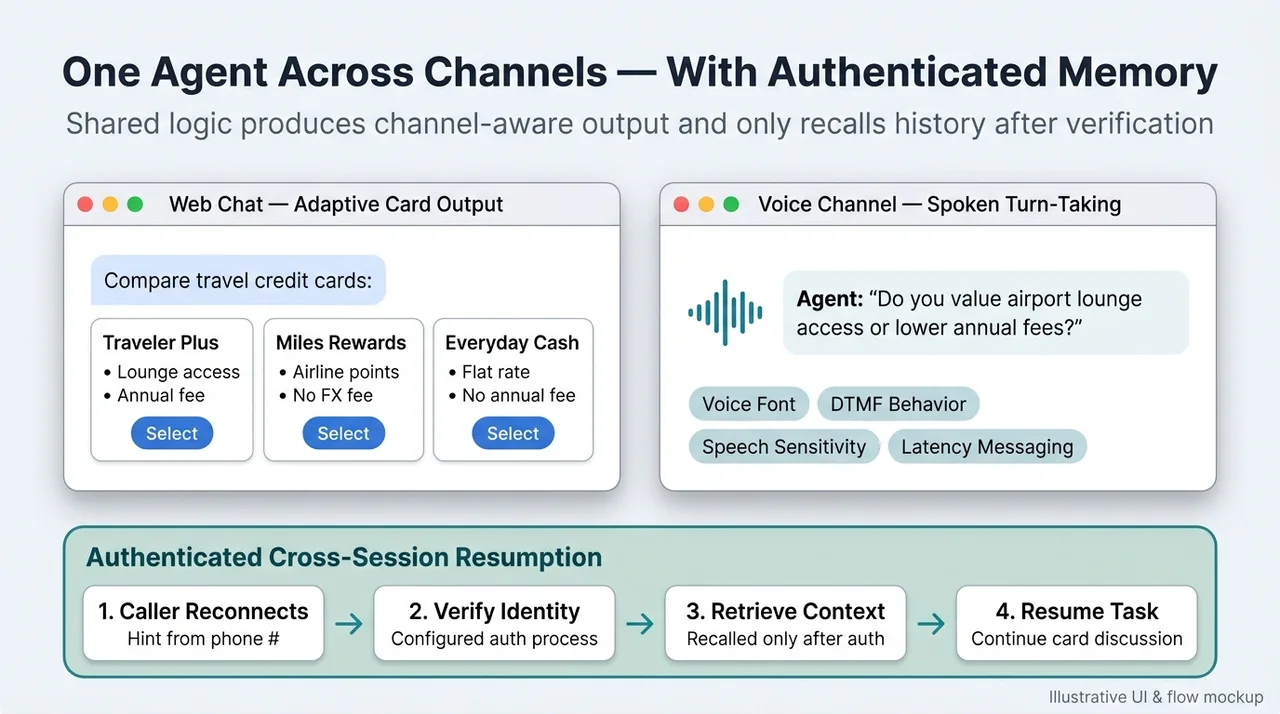
Microsoft describes CCI agents as omnichannel, multilingual, and channel-aware, with near-term and long-term memory across digital and voice interactions. The GA announcement also lists voice configuration options including voice fonts, speech instructions, dual-tone multi-frequency (DTMF) behavior, speech sensitivity, and latency messaging.
Omnichannel should not mean delivering identical output everywhere.
A web chat can display several card options in an Adaptive Card (an interactive UI card with buttons and comparisons). A voice agent needs to present a manageable spoken choice. Reading a dense comparison aloud is technically possible and operationally unhelpful.
The Ignite demonstration illustrated this difference: the same banking experience used a rich web interface for card selection and spoken dialogue to narrow preferences over the phone.
Shared agent logic can reduce duplicated development. Channel-aware presentation remains essential.
Memory changes the unit of service
In the live demonstration, a disconnected caller returned and resumed the earlier credit card discussion after authentication. The presenter explicitly stated that previous conversation information was recalled only for an authenticated customer.
That sequence matters. A returning phone number is not sufficient reason to reveal a previous customer’s conversation.
The useful pattern is:
- Associate the returning interaction with a possible customer.
- Establish identity using the configured authentication process.
- Retrieve the appropriate context.
- Resume the task rather than restarting the interview.
The broader implication is that a customer journey can span multiple calls or channels. A disconnected call is not necessarily a failed service outcome if the customer resumes and completes the task. Conversely, one short call is not necessarily successful merely because it ended without escalation.
Voice Models: Separate the Architecture From the Roadmap
Voice systems commonly use one of two architectures, each with different trade-offs in latency, observability, conversational behavior, and component control:
- Cascade: Speech recognition converts audio to text, a language model processes the request, and speech synthesis converts the response back to audio.
- Speech-to-speech: Spoken interaction is processed directly through an audio-oriented model interface.
CCI supports voice configuration and model choice, but two launch statements require careful qualification:
- Per-specialist model selection: The November GA announcement says that choosing a separate model for each specialist agent is coming soon. The earlier harness announcement had described that capability as expected at GA, while the more recent CCI announcement still places it on the roadmap—so it should not be presented as a confirmed current CCI control.
- MAI Realtime 1 speech-to-speech: CCI’s announcement says it will offer Microsoft’s new speech-to-speech model. The model’s own announcement names it MAI Realtime 1 and describes a Microsoft Foundry limited-access preview. See the MAI Realtime 1 announcement.
Microsoft reports strong results on Big Bench Audio and Tau-Voice, as well as internal product evaluations. Those are vendor-reported findings under specified evaluation conditions, not proof that the model will outperform alternatives in every contact center. Microsoft itself notes that performance, latency, and cost comparisons vary by workload and methodology.
For a service team, the meaningful test is its own interaction: the actual language, background noise, tools, policies, and response-time expectations. A benchmark is useful evidence, not a substitute for that evaluation.
Business Context: Knowledge Is Not the Same as Authority
A conversational agent needs more than fluent language. It needs reliable information about the business.
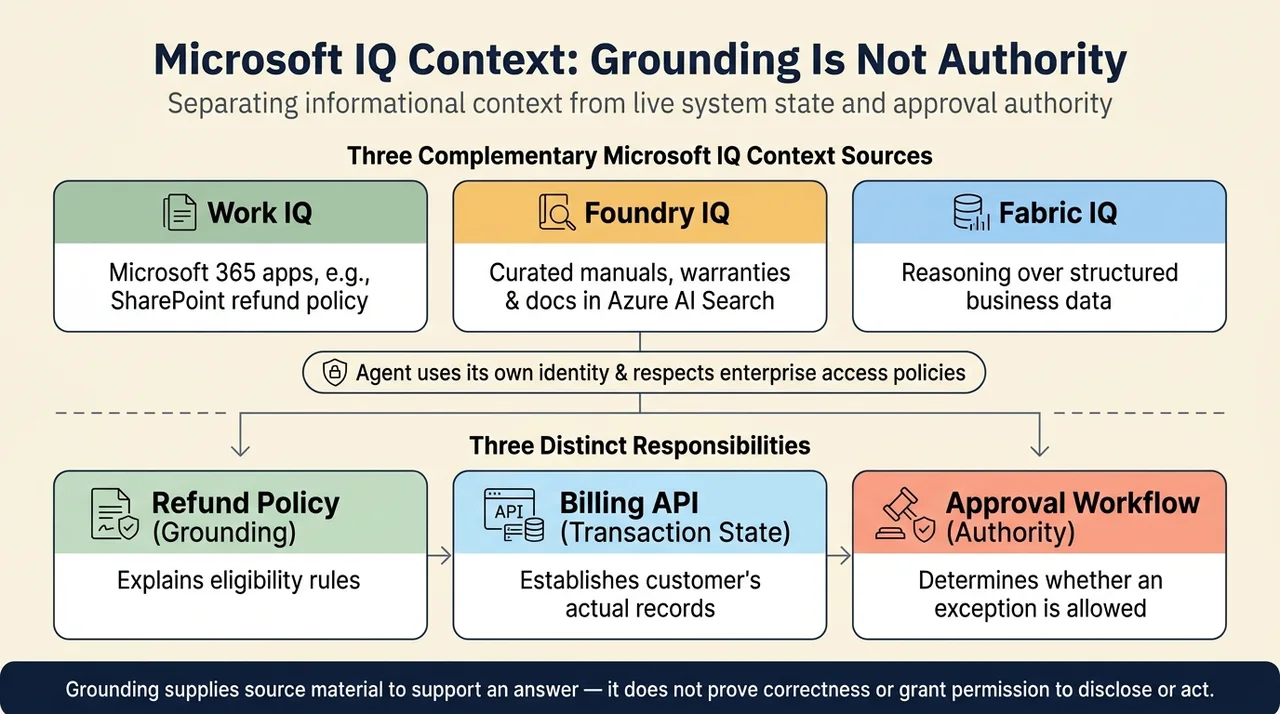
Microsoft describes CCI’s integration with Microsoft IQ through three complementary sources of context:
- Work IQ: information from Microsoft 365 applications, such as a refund policy stored in SharePoint.
- Foundry IQ: curated knowledge sources, including manuals, warranties, and documents indexed in Azure AI Search.
- Fabric IQ: reasoning over business data.
These relationships are described in the CCI GA announcement. The harness announcement further explains that an agent accesses organizational information using its own identity and respects enterprise access policies.
Grounding is the process of supplying relevant source information to support an answer. It is not a guarantee that every answer is correct, and it is not permission to disclose everything the agent can retrieve.
For example, a refund policy can explain eligibility. A billing API can establish the customer’s actual transaction state. An approval workflow can determine whether an exception is allowed. These are related, but distinct, responsibilities.
The launch presentation also described customer interactions feeding back into organizational context. Microsoft’s GA article places that enrichment in investments planned over the coming months. It should be understood as a direction of travel, not as evidence that every call currently updates enterprise knowledge automatically.
Voice Biometrics: Reduce Friction Without Confusing Identity and Permission
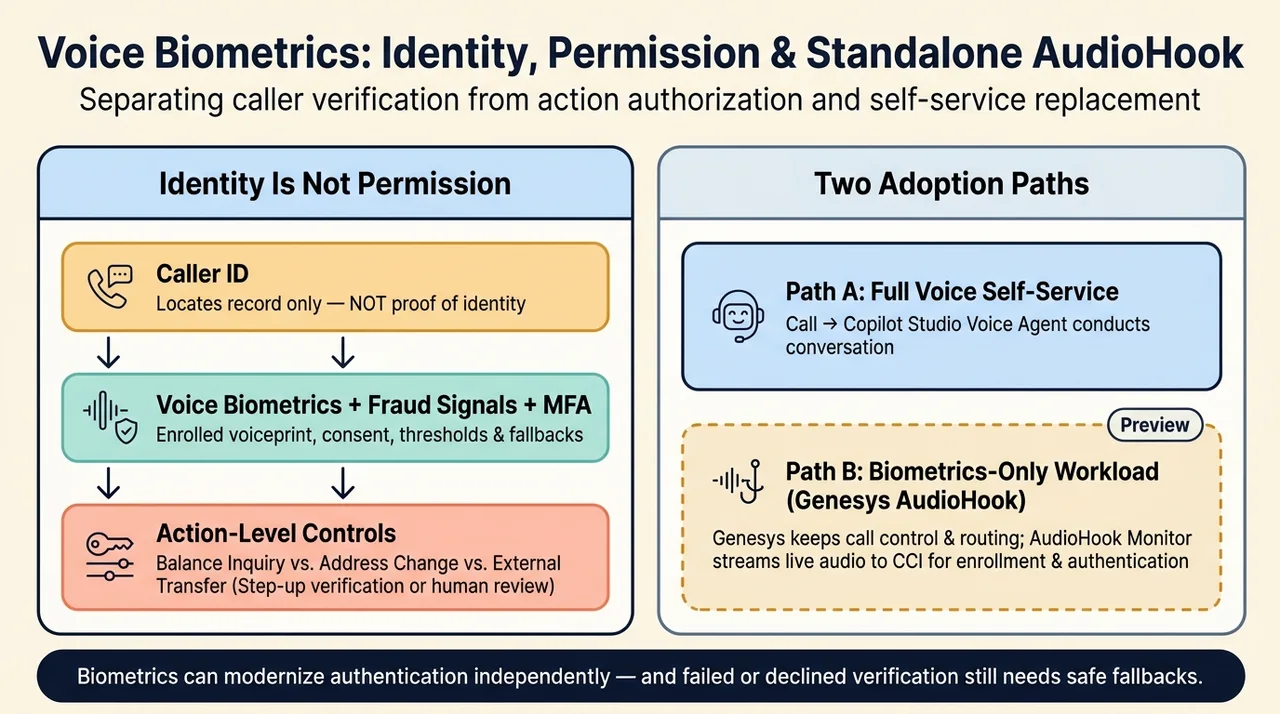
CCI supports authenticating customers during a conversation by comparing their speech with an enrolled voiceprint. Microsoft’s overview describes combining supported identity evidence, voice biometrics, fraud signals, and multifactor authentication, with organization-defined consent, thresholds, retries, fallback procedures, and human review.
The Ignite demonstration showed a returning caller being authenticated and a different speaker being rejected. It also described protections against spoofing, replay, and synthetic speech.
Those demonstrations are useful illustrations, but they do not establish measured resistance to every deepfake or attack. No false-acceptance rate, false-rejection rate, or attack evaluation methodology was supplied in the source material. The defensible conclusion is that biometric authentication and anti-fraud capabilities are part of the product, not that voice authentication is infallible.
Caller ID can help locate a customer record. It should not be treated as proof of identity. Successful authentication also does not authorize every requested action.
A balance inquiry, an address change, and an external transfer can require different controls. Sensitive actions may still need step-up verification or human review. Customers also need a usable alternative when they decline enrollment or cannot authenticate successfully.
Biometrics can be a separate modernization workload
The Genesys AudioHook integration documentation reveals an important architectural distinction.
AudioHook Monitor can stream live call audio to CCI for enrollment and authentication while Genesys retains call control and routing. This is different from connecting a call to a Copilot Studio voice agent that conducts the conversation.
In other words, adopting CCI does not have to mean replacing self-service first. Authentication can be introduced as a separate workload where the supported integration permits it. However, this specific AudioHook path remains preview and should be evaluated under its documented restrictions.
Integration: “No Rip and Replace” Does Not Mean “No Engineering”
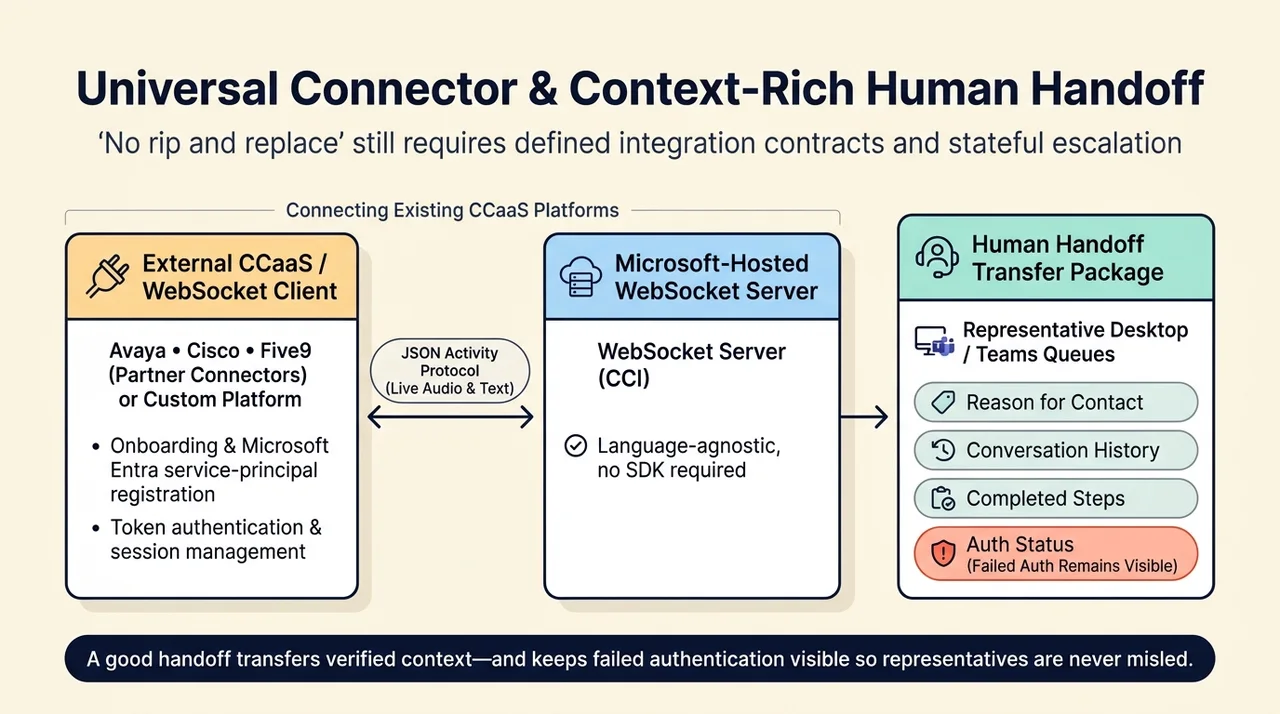
Microsoft announced partnerships with Avaya, Cisco, and Five9 to build and maintain out-of-the-box connectors. Its GA announcement also describes pre-built connectors and a universal connector for connecting to existing CCaaS platforms.
A partnership announcement is not a feature-parity matrix. The exact vendor product, channel, integration path, and release status still matter. A platform name appearing in a demonstration does not establish support for every edition or deployment configuration.
The universal connector reference makes the underlying work explicit. It describes a Microsoft-hosted WebSocket server where the external platform acts as a WebSocket client and exchanges JSON messages through a standardized format called the Activity Protocol, with live audio and text session types.
That path involves onboarding, Microsoft Entra service-principal registration (registering an application identity for server-to-server access), token authentication, session management, and audio or text exchange. It is language-agnostic and does not require an SDK, but it is still an integration contract that someone must implement or provide.
The practical distinction is:
- A supported native integration can make configuration straightforward.
- A universal interface makes broader integration possible.
- Neither establishes that every production deployment requires only copying a few credentials.
The roughly seven-minute stage demonstration showed a prepared scenario being configured and exercised. It did not measure the time needed to prepare business APIs, review permissions, obtain consent, test failures, or complete production acceptance.
Human handoff is part of the architecture
Microsoft states that CCI can hand customers to representatives in their existing desktop while carrying context and voice authentication across the transfer. The harness also describes escalation to Teams queues.
The source presentation mentioned additional destinations, including Teams chats, channels, phone, and email. Those should not be treated as an interchangeable list of confirmed current escalation capabilities. The documented queue and contact-center handoff paths are the stronger basis for planning; other destinations require feature-specific confirmation.
A good handoff preserves the reason for contact, relevant conversation history, completed steps, and authentication status. A failed authentication must remain visible as a failure, not disappear during transfer.
Quality Assurance: Evaluate the Conversation You Actually Captured
CCI includes AI-assisted quality evaluation and operational dashboards. But “every interaction is scored” is an oversimplification.
The quality assurance documentation defines two main building blocks:
- Quality indicators: questions and scored answer options describing good performance.
- Evaluation plans: rules specifying frequency, eligible conversations, sampling percentage, and indicators.
Plans can evaluate conversations in real time or on close. Real-time scores can change as the conversation develops. On-close results include a score, evaluation summary, suggested actions, and indicator-level explanations.
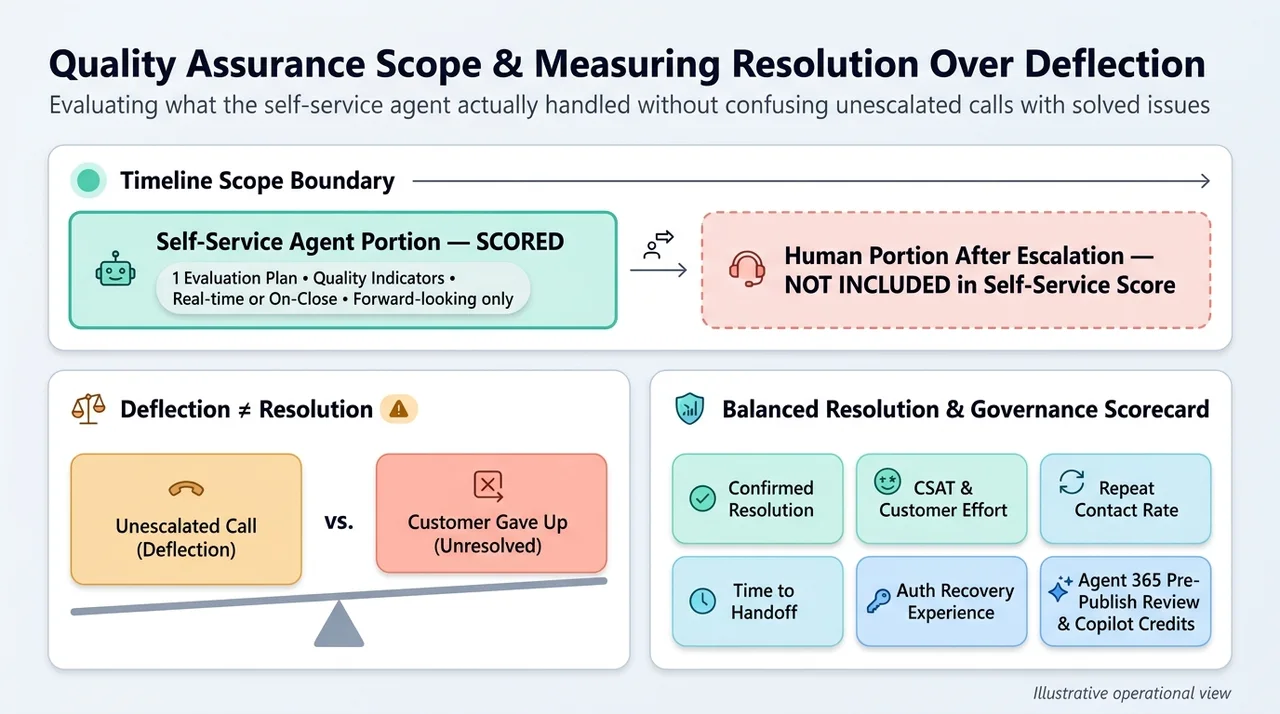
Crucially, the current documentation says that the self-service quality score covers only the portion handled by the self-service agent. A human representative’s portion after escalation is not included in that score.
That is narrower than the launch language about grading the full customer journey. An end-to-end quality program needs to account for the boundary rather than assuming the self-service score covers everything.
Other documented limits matter operationally:
- Sampling determines which eligible conversations are evaluated.
- Plans are forward-looking, not retroactive.
- Existing scores cannot be recalculated after an indicator changes.
- Only one evaluation plan scores a conversation.
An AI-generated score is also an assessment against a rubric, not independent proof of resolution or compliance. Teams should review explanations and compare evaluations with human judgments, especially before using scores for consequential decisions.
Measure Resolution, Not Just Deflection
The partner discussion at Ignite made an important point: containment (keeping interactions in self-service without handing off to a human) can rise while customer satisfaction falls.
Microsoft’s real-time dashboard documentation makes the distinction explicit. Deflection is the percentage of completed conversations that were not escalated to a human representative. It does not necessarily confirm issue resolution.
A customer who gives up can disappear from the queue without receiving useful service.
A stronger evaluation combines:
- Task completion or confirmed resolution.
- Customer satisfaction and effort.
- Repeat contact for the same issue.
- Appropriate escalation and time to handoff.
- Authentication success and recovery experience.
- Quality findings and policy adherence.
The source included a partner-reported healthcare deployment completed in six weeks with approximately 40% deflection or containment. The discussion used those terms inconsistently and did not provide the denominator, observation period, or resolution criteria. It is an anecdotal deployment claim, not a general performance expectation.
Similarly, the transcript’s return-on-investment comparison was incomplete and cannot support a numerical conclusion. The architectural case for incremental modernization does not need an unreliable financial claim to make it compelling.
Governance and Consumption Belong in the Pilot, Not After It
CCI’s GA announcement says agents appear in Microsoft Agent 365 upon creation, before publication. Administrators can inspect ownership, channels, identity, knowledge sources, tools, and granted permissions.
That visibility is useful precisely because a conversational agent can do more than answer questions. It can retrieve information and invoke business actions. Registry visibility should therefore lead to an actual review of its scope, not be mistaken for automatic approval.
Consumption also deserves a bounded place in evaluation. Microsoft’s CCI introduction highlights two separate cost layers:
- Microsoft consumption: Usage-based Copilot Credits for CCI interactions.
- Third-party CCaaS charges: Separate vendor fees for API or voice-channel access.
Model-level audio pricing should not be substituted for the total price of a CCI service. Evaluate the configured workload, its Microsoft consumption, and any vendor integration charges. The source does not provide enough evidence for a defensible per-call estimate.
A Useful First Pilot: One Journey, Several Failure Paths
The best starting point is not a miniature version of the entire contact center. It is one bounded customer journey with a measurable outcome.
Microsoft offers a 30-day CCI trial. Its prerequisites include a work or school account, an eligible Dataverse environment or the ability to create a trial environment, and geographical availability. Trial resources are not intended for production workloads.
For an illustrative credit card information journey, a useful evaluation would:
- Define success before building. Decide what counts as a useful recommendation, completed task, or appropriate escalation.
- Prepare approved knowledge and tools. Separate product explanations from authenticated account data and transaction actions.
- Build the hybrid interaction. Use generative exploration for preferences and controlled topics for required steps.
- Exercise voice and chat. Check spoken choices, rich chat presentation, interruptions, silence, and the languages customers actually use.
- Test identity and continuity. Include returning callers, declined consent, failed authentication, disconnections, and safe resumption.
- Validate handoff. Confirm routing, transcript availability, authentication status, and the representative’s ability to continue the task.
- Configure quality evaluation before collecting evidence. Plans do not retroactively score earlier conversations.
- Compare outcomes with the baseline. Do not declare success solely because fewer conversations reached a person.
This is where the stage demonstration becomes useful: not as a deployment-time promise, but as a set of behaviors worth reproducing under real operating conditions.
The Real Shift: Decoupling AI Adoption From Platform Replacement
CCI’s strongest idea is not a more natural voice or a faster way to build a bot. It is the separation of conversational modernization from contact center replacement.
An organization can improve self-service, authentication, and evaluation while retaining systems its representatives already know. A full migration can still make sense when routing, workforce capabilities, desktops, or broader platform limitations need to change. The overlay approach does not make those requirements disappear.
It does, however, create a more focused decision: which customer journey should improve next, and what evidence will show that it improved?
That is a better starting point than replacing menus with an LLM and hoping the experience becomes intelligent. The real work is connecting conversation, knowledge, identity, controlled action, and human expertise into a service that resolves the customer’s need.
Read next